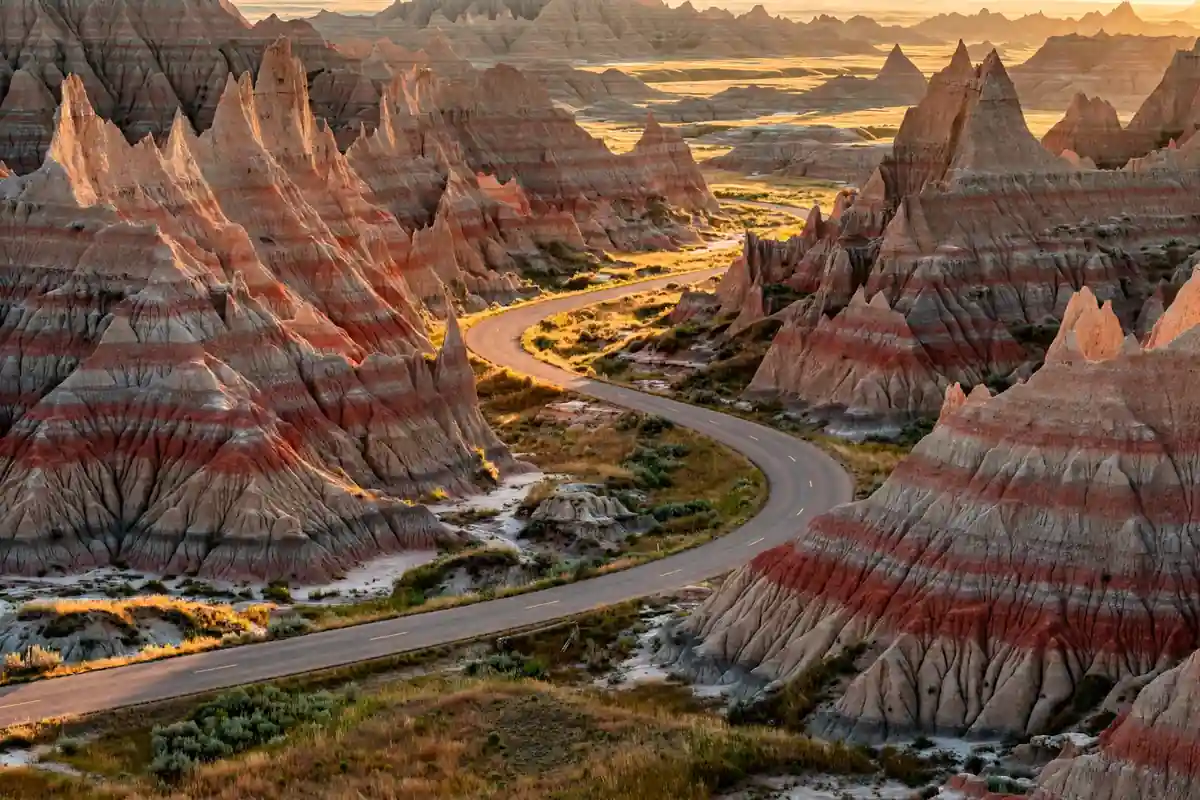
The Badlands look like another planet dropped into the South Dakota prairie. Layered spires, striped canyons, and crumbling pinnacles stretch to the horizon, ringed by one of the largest protected grasslands in the country. This Badlands National Park guide covers the scenic Loop Road, the best short hikes, and the wildlife and fossil stops that make a first visit easy and unforgettable.
The park is compact and wonderfully driveable: most highlights sit along one paved road, which means you can see a great deal in a single day — though sunrise and sunset will tempt you to stay longer.
Badlands National Park Guide to the Loop Road
The Badlands Loop Road (Highway 240) is the park’s main event. This paved route of roughly 30 miles connects the northeast entrance near the Ben Reifel Visitor Center with the town of Wall on Interstate 90, passing a dozen overlooks and trailheads along the way.
Start at the Ben Reifel Visitor Center, where rangers check conditions and the fossil preparation lab lets you watch paleontologists at work on real specimens. From there, the road climbs through the Badlands Wall — the dramatic escarpment that gives the park its name — and the views begin immediately.
Do not rush the overlooks. Big Badlands Overlook delivers the classic sunrise panorama, Conata Basin glows with pastel-striped formations, and the Yellow Mounds area shows off the park’s most surprising colors. Allow at least two to three hours for the loop with stops, and half a day if you add the short hikes below. Drivers crossing the plains can string this drive together with others using our ultimate USA road trip planner.
The Best Short Hikes in the Badlands
Badlands trails are short, exposed, and unlike anything else in the park system. Most are under two miles, but the sun and heat are the real challenge — carry water on every one.
Door Trail
The Door Trail is the essential Badlands walk. A boardwalk of about three-quarters of a mile leads through a narrow opening — the “Door” — in the Wall, emerging onto a surreal landscape of eroded pinnacles. Marked posts guide you across the broken terrain beyond the boardwalk. Go early in the morning for soft light and cool temperatures.
Window Trail and Notch Trail
The tiny Window Trail (about a quarter mile) frames a perfect view through a natural opening in the rock. Nearby, the Notch Trail is the park’s most adventurous short hike: about 1.5 miles round trip, it follows a canyon wash, climbs a sturdy log ladder, and traverses a narrow ledge to a window view over the valley. It is not for anyone afraid of heights, and the ladder is a genuine climb — but it is many visitors’ favorite hour in the park.
Cliff Shelf and Fossil Exhibit Trails
The Cliff Shelf Nature Trail loops about half a mile through a surprisingly green juniper area fed by seeping water, with good birdwatching and shade rare elsewhere in the park. The Fossil Exhibit Trail is a fully accessible boardwalk lined with fossil replicas and displays explaining the ancient mammals — rhinos, horses, and saber-toothed cats — whose bones weather out of these hills. If painted-desert geology fascinates you, our petrified forest national park guide covers Arizona’s version, while the great sand dunes guide shows Colorado’s very different landscape.
Badlands Wildlife: Bison, Sheep, and Prairie Dogs
The formations share the stage with serious wildlife. A bison herd roams the park’s western grasslands, bighorn sheep pick their way along the cliffs near the Pinnacles Entrance, and pronghorn graze the prairie edges. Give all of them room — bison are fast, unpredictable, and far less tame than they look.
For the Sage Creek Rim Road area in the west, the gravel road passes Roberts Prairie Dog Town, where a bustling colony chirps and dives within easy view of the pullouts. Black-footed ferrets, one of North America’s rarest mammals, hunt these towns at night, though you are unlikely to spot one. The primitive Sage Creek Campground nearby is free and first-come, first-served, and bison occasionally wander through it.
Speaking of camping: the developed Cedar Pass Campground near the visitor center takes reservations and sits beneath the formations — the exposed-desert advice in our Death Valley camping guide applies here too — and the area is a stargazer’s dream. Summer night-sky programs are a park tradition, and our rv rental guide for beginners helps if you are bringing your lodging with you.
The Badlands Fossil Story
These hills are one of the world’s great fossil treasure chests. The striped layers were laid down tens of millions of years ago, when this region shifted from an ancient sea to forests and floodplains roamed by early mammals. Erosion now exposes their bones at a remarkable rate — after heavy rains, fresh fossils can quite literally weather out of the slopes.
The stars of the fossil beds include oreodonts (sheep-sized grazing mammals found here in huge numbers), three-toed horses, pig-like entelodonts, nimravids — the “false saber-tooth” cats — and huge thunder beasts called brontotheres. The fossil preparation lab at the Ben Reifel Visitor Center lets you watch scientists clean and study real specimens, and in summer, paleontology programs sometimes run at the lab or out in the field. If you find a fossil, the park asks you to leave it exactly where it lies and report the location to a ranger: context is what makes a fossil scientifically valuable, and collecting is not allowed.
Beyond the Loop: Wall and the Minuteman Missile Site
The town of Wall anchors the park’s west end, famous for Wall Drug, the sprawling roadside store that has advertised free ice water to travelers since the 1930s. It is kitschy, enormous, and genuinely fun for an hour — and the town has the motels and diners most visitors use as a base.
Just outside the park’s northeast entrance sits the Minuteman Missile National Historic Site, where Cold War missile silos and a launch control facility tell a very different American story. Ranger-led tours of the underground control center are limited and worth booking ahead. Pairing natural and historical stops like this is a theme of our national park trip planning guide, and drivers heading west can continue to Mount Rushmore and the Black Hills, roughly an hour and a half away.
When to Visit the Badlands
Late spring and early autumn are the sweet spots: mild temperatures, green prairie in May and June, and thinner crowds. Summer brings long days and full services but also serious heat — temperatures regularly top 100°F with almost no shade, so hike at dawn and carry more water than seems reasonable. Our white sands national park guide shares the same desert logic for New Mexico’s dunes.
Winter is stark and silent, with bitter wind and occasional road closures; services shrink to almost nothing. Most first-time visitors should aim for May, June, or September. Whenever you come, plan at least one sunrise or sunset: the formations shift from gray to pink to deep orange, and the park’s layered colors — best seen on the routes in our utah mighty 5 road trip itinerary as well — are at their richest in low light.
A Sample One-Day Badlands Itinerary
Sunrise: Start at Big Badlands Overlook as the first light sets the spires glowing, then walk the Door and Window trails while the air is still cool. Morning: Take on the Notch Trail before the heat builds, then recover at the visitor center — exhibits, fossil lab, and a water refill. Afternoon: Drive the loop westward at a lazy pace, stopping at Conata Basin and the Yellow Mounds, with the Cliff Shelf and Fossil Exhibit trails as short, shady breaks. Evening: Watch for bighorn sheep near the Pinnacles Entrance, grab dinner in Wall, and return to an overlook for sunset — or stay for a ranger night-sky program and some of the best stargazing in the Midwest.
Frequently Asked Questions
How long do I need in Badlands National Park?
One full day covers the Loop Road, the main short hikes, and a sunset. Two days adds the Sage Creek area, a ranger program, and a more relaxed pace.
Is the Badlands Loop Road suitable for RVs?
Yes, the paved loop handles RVs, though some tunnels and tight sections on nearby Black Hills roads (outside the park) have low clearances — check your route. The gravel Sage Creek Rim Road is rougher and best for high-clearance vehicles in wet weather.
Can I hike off-trail in the Badlands?
Yes — the park allows open hiking and backcountry camping in most areas, which is unusual. The formations are fragile and disorienting, though, so carry a map, GPS, and far more water than you think you need, and tell someone your plan.
What is the closest town to Badlands National Park?
Wall, South Dakota, sits at the park’s western entrance with motels, restaurants, and Wall Drug. Interior, a tiny town near the southeast, is closest to the visitor center side.
Final Thoughts
The Badlands prove that a park does not need to be huge to feel epic. One scenic road, a handful of short trails, herds of bison, and fossil-rich hillsides tens of millions of years in the making add up to one of the most distinctive landscapes in America. Come for the geology, stay for the sunset, and keep exploring with our Grand Canyon South Kaibab Trail guide and Arches National Park hikes for more desert country inspiration.