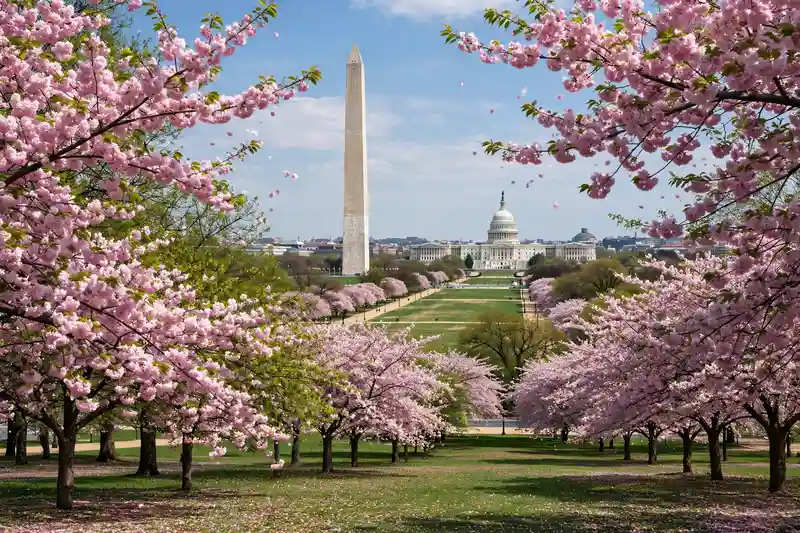
Washington DC might be the best-value big city in America for visitors. The monuments are free, the great museums are free, and many of the best things to do in Washington DC sit within walking distance of each other on one grand, green lawn. Add historic neighborhoods and easy day trips, and you have a trip that feels rich without costing much.
This guide starts on the National Mall, moves through the museums and neighborhoods, and finishes with practical planning help. Whether it is your first visit or your fifth, you will find something new below — the city rewards repeat trips more than almost anywhere in the country.
The Best Things to Do in Washington DC on the National Mall
The Mall stretches about two miles from the US Capitol to the Lincoln Memorial, with the Washington Monument at its center. Walk it slowly. The monuments read like a timeline of American history, and nearly all of them are open around the clock and free.
Start at the Capitol end. Tours of the Capitol building are free but should be booked in advance, and the nearby Library of Congress — especially its ornate Main Reading Room overlook — is one of the most beautiful interiors in the country. The Supreme Court and the US Botanic Garden sit within the same cluster, so you can see all four in a morning.
Midway along the Mall stands the Washington Monument. Tickets to ride to the top are free but timed, and they are released online ahead of time, so reserve before your trip. Even without a ticket, the grounds make a fine picnic spot with views in every direction.
At the western end, the memorials cluster together. The Lincoln Memorial at dawn or after dark is unforgettable, and the nearby Vietnam Veterans Memorial and Korean War Veterans Memorial are quietly powerful. The Martin Luther King Jr. Memorial and the Tidal Basin sit just south, and in late March or early April the basin’s cherry blossoms turn the whole area pink.
Inside the Free Museums
The Smithsonian Institution runs a string of free museums along the Mall, and choosing between them is the hardest part of a DC trip. The National Air and Space Museum displays the Wright brothers’ plane and Moon-era spacecraft. The National Museum of Natural History holds the Hope Diamond and a beloved elephant rotunda. The National Museum of American History preserves the original Star-Spangled Banner.
Art lovers should split time between the National Gallery of Art — free, though run separately from the Smithsonian — and the Smithsonian American Art Museum near Gallery Place, which also houses the National Portrait Gallery. The National Museum of African American History and Culture is essential and moving; its timed-entry passes go quickly, so reserve early.
Pace yourself. Two museums a day is a realistic maximum if you actually want to remember them. Museum fatigue is real, and every one of these buildings will still be here — and still free — on your next visit.
Two more stops round out a museum day. The National Archives displays the Declaration of Independence, the Constitution, and the Bill of Rights in a hushed rotunda — arrive early or reserve a timed entry to skip the longest lines. Across the Mall, the Hirshhorn Museum wraps modern art and sculpture around a circular courtyard, and its sunken sculpture garden across the street is one of the Mall’s calmest corners.
Families should also save half a day for the Smithsonian’s National Zoo in Woodley Park. It is free like the other Smithsonian sites, spread along a wooded hillside in Rock Creek Park, and known for its giant pandas and Asia Trail. Entry passes are typically arranged online ahead of time, and pairing the zoo with lunch on Connecticut Avenue makes an easy, kid-approved itinerary away from the Mall crowds.
Neighborhoods Beyond the Mall
Georgetown is the classic detour: cobblestone streets, Federal-era houses, a lively waterfront park, and shopping along M Street and Wisconsin Avenue. Walk the C&O Canal towpath, then climb the famous Exorcist Steps if you are a film fan.
Capitol Hill offers a more local version of the city. Eastern Market has anchored the neighborhood since the 1870s with food stalls and weekend flea markets, and the surrounding streets of rowhouses are made for wandering. It pairs naturally with a morning at the Capitol and Library of Congress.
For evenings, look to the U Street Corridor and Adams Morgan. U Street was once known as Black Broadway and still runs on live music and late-night eats — try a half-smoke, the city’s signature chili-topped sausage. Adams Morgan stacks bars, bookshops, and restaurants from five continents along 18th Street.
Across the river in Virginia, Arlington National Cemetery deserves a respectful half day. The Changing of the Guard at the Tomb of the Unknown Soldier runs on a precise schedule year-round, and the Kennedy gravesites and Arlington House complete the visit. Old Town Alexandria, a little further south, adds waterfront dining and King Street’s shops.
Easy Day Trips from Washington DC
George Washington’s Mount Vernon estate, about 15 miles south along the Potomac, is the most popular day trip, and it earns it. The mansion, gardens, working farm, and museum fill half a day easily, and the riverside setting is lovely in every season.
Nature lovers should aim west. The Skyline Drive and trails in our Shenandoah National Park guide begin roughly 70 miles from the city, close enough for a long day of overlooks and waterfalls. History buffs can choose Gettysburg to the north or Colonial Williamsburg to the south, both straightforward drives.
Prefer to stay on rails? The Northeast Corridor makes car-free escapes simple, as our Amtrak train travel guide shows — Baltimore in under an hour, Philadelphia in about ninety minutes, and New York beyond that. Our Boston weekend itinerary completes the corridor if you are stringing cities together.
Evenings in Washington DC
DC does not close when the museums do. The Kennedy Center’s Millennium Stage hosts free performances every evening, ranging from jazz quartets to dance troupes, and the building’s terrace overlooks the Potomac at sunset. It is the best free night out in the city.
For dinner and a stroll, the Wharf district along the southwest waterfront has rebuilt itself into a string of restaurants, music venues, and fire pits on the piers. Georgetown’s waterfront and the U Street corridor offer two more evening moods — polished and lively, respectively. Pick one per night and the city after dark feels completely different from the marble version of the daytime.
Practical Tips for Your Visit
The Metro is clean, simple, and reaches nearly everything in this guide. Load a SmarTrip card or use contactless payment, and avoid weekday rush hours when government workers fill the trains. Navigation apps help with the Mall’s deceptive distances — our picks for the best travel apps cover transit and museum planning together.
Book the timed things early: Washington Monument tickets, Capitol tours, the African American History museum passes, and White House tours (arranged through your member of Congress well in advance). Everything else can stay spontaneous.
Weather swings by season. Spring and fall are the sweet spots, summer is hot and humid, and winter is cold but crowd-free. Pack accordingly — our carry-on packing list covers a long weekend, and layers matter most in the shoulder seasons. For a longer East Coast trip, a glance at our travel insurance guide is worth it before you prepay hotels and tours.
First-timers often underestimate how much walking a DC day involves. The orientation in our USA travel guide for first-time visitors helps set expectations, and the street smarts in our travel safety tips apply in the capital like anywhere else.
Quick Questions, Answered
How many days do you need in Washington DC? Three days covers the Mall, two or three museums, and one neighborhood or day trip. Four or five days lets you slow down and see far more.
Are the museums really free? Yes. All Smithsonian museums and the National Gallery of Art offer free admission. A few require free timed-entry passes, so reserve those ahead.
What is the best free thing to do at night? Walk the monuments after dark. The Lincoln Memorial and the Korean War Veterans Memorial are especially atmospheric when lit, and the crowds are gone.
What should I skip if time is short? Protect the Mall, one major museum, and one neighborhood, in that order. The monuments and one deep museum visit deliver the essential DC experience; everything else, however good, is a bonus you can catch on a return trip.
Keep Exploring the East Coast
DC pairs beautifully with its historic neighbors. The squares and food scene in our Charleston travel guide make a fine southern counterpoint, and the day-trip towns in our roundup of the best small towns in the USA include several within an easy drive of the capital. Whichever direction you head next, Washington sets a high bar — few cities give visitors this much, for this little.