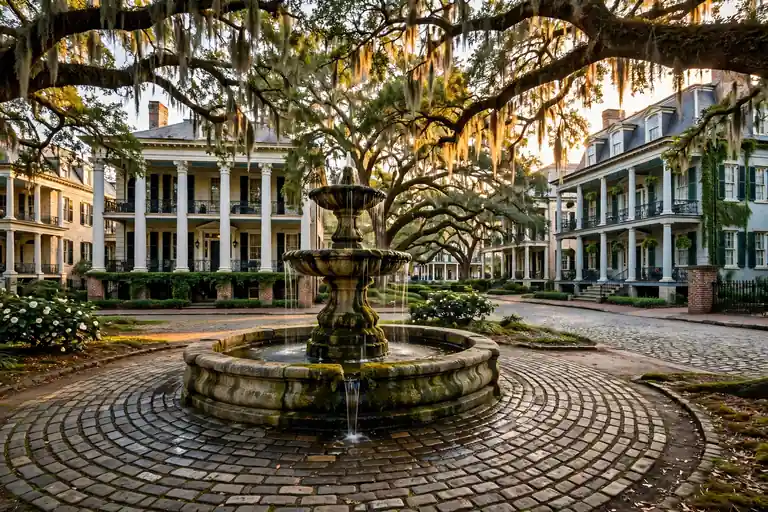
The best things to do in Savannah revolve around a simple pleasure: walking slowly through one of the most beautiful historic districts in America. Savannah was laid out in 1733 around a grid of leafy public squares, and more than 20 of those squares survive today, each shaded by live oaks dripping with Spanish moss. Add a riverfront of old cotton warehouses, famous Southern cooking, and a proudly haunted reputation, and you have a city that fills two or three days with ease.
This guide covers the squares and streets to wander, the historic homes and museums worth your ticket money, where to eat, and how to do Savannah after dark. It closes with practical tips and a beach escape to Tybee Island.
Wandering the Historic District and Its Squares
Start where everyone starts: Forsyth Park, the 30-acre green heart of the city, anchored by its white cast-iron fountain from 1858. From Forsyth, walk north along Bull Street and you will cross a chain of the great squares — Monterey, Madison, and Chippewa among them. Chippewa Square is where the famous bench scenes from Forrest Gump were filmed, though the bench itself now sits in a local history museum.
Each square has its own personality. Johnson Square, the oldest and largest, buzzes with office workers at lunch. Wright Square holds the memorial to Tomochichi, the Yamacraw chief who helped the colony survive. Lafayette Square sits beside the Cathedral Basilica of St. John the Baptist, whose twin spires and stained glass reward a quiet visit inside. The genius of Savannah’s plan is that you cannot really get lost: the grid guides you, and every few blocks a new square offers benches, shade, and a statue with a story. Travelers comparing Southern cities usually pair Savannah with our Charleston travel guide, its sister port city two hours north.
Jones Street and the Mercer-Williams House
Jones Street is often called one of the prettiest streets in America, with brick townhouses, gas lanterns, and window boxes in every season. On Monterey Square nearby, the Mercer-Williams House draws fans of Midnight in the Garden of Good and Evil, the book and film that made Savannah famous worldwide. Book the house tour ahead on busy weekends.
Historic Homes, Churches and Museums
Savannah’s house museums show how the city lived across three centuries. The Owens-Thomas House, a Regency masterpiece from 1819, includes one of the best-preserved urban slave quarters in the South and tells both stories honestly. The Davenport House, saved from demolition in 1955, launched the preservation movement that rescued the whole district. The Juliette Gordon Low Birthplace honors the founder of the Girl Scouts, an organization born in Savannah in 1912.
For a broader sweep, the Telfair Museums combine the Telfair Academy’s art collection with the contemporary Jepson Center, and the Savannah History Museum inside the old train station makes a fast, useful orientation stop. If your Southern loop continues to Louisiana, our New Orleans travel guide covers a French Quarter that pairs beautifully with Savannah’s squares — same moss, different music.
Fort Pulaski and the Road to the Sea
History lovers should add one more stop: Fort Pulaski National Monument, the massive brick fort on Cockspur Island between Savannah and Tybee. In 1862, Union rifled cannons breached its walls from across the water and changed military history, ending the age of masonry forts in a single battle. Today you can walk the ramparts, watch cannon demonstrations on many weekends, and hike marsh trails with wide views of the Savannah River — then be on Tybee’s beach within fifteen minutes.
The same road passes the turnoff for Wormsloe State Historic Site, where a mile-long avenue of live oaks leads to the tabby ruins of an 18th-century estate. The oak avenue alone is one of the most photographed scenes in Georgia, and arriving early gives you the light and the quiet to enjoy it properly.
Shopping Streets and Sweet Stops
Broughton Street is Savannah’s traditional main street, mixing local boutiques, the historic Lucas Theatre, and beloved stops like Leopold’s. A few blocks south, the Design District around Whitfield Square and the shops of Bull Street add antiques, books, and Southern-made goods. Shopping here is pleasantly unhurried: most stores are locally owned, many sit inside historic buildings, and staff are happy to share the story behind what they sell. Save an hour for it between the squares and dinner — Savannah’s souvenirs tend to be things you will actually keep.
River Street, the Waterfront and Tybee Island
When you are ready for noise and cobblestones, head down to River Street, where 19th-century cotton warehouses now hold candy kitchens, galleries, and rooftop bars above the Savannah River. Watch container ships glide past, ride the free ferry to Hutchinson Island for skyline photos, and browse the City Market blocks just inland for local art and ice cream.
Need sand? Tybee Island is about 25 minutes east and gives Savannah a true beach day: a wide Atlantic beach, a historic lighthouse you can climb, and casual seafood shacks along the main drag. Beach variety is a Savannah strength, and our list of the best beaches in the USA shows how Tybee’s laid-back style compares with bigger-name shores. River Street also makes a fine starting point for the coastal leg of a great American road trip heading down toward Florida.
Things to Do in Savannah After Dark: Ghost Tours and Nightlife
Savannah calls itself one of America’s most haunted cities, and after dark it works hard to prove it. Evening ghost tours range from history-heavy walking tours to theatrical hearse tours that lean into the spooky. The stories center on real Savannah history — duels, epidemics, and the fact that much of the old city was built over burial grounds — which makes even skeptics enjoy the ride. Book the later departures; the squares under gaslight are worth the wait.
For a gentler night, Savannah’s open-container rules in the historic district let you carry a drink in a plastic cup as you stroll, a tradition locals call a “to-go cup.” Live music spills from City Market bars, and rooftop spots above River Street give you the river and the Talmadge Bridge lit up at night. Couples rate Savannah among the most romantic cities in the South, a theme we explore in our guide to honeymoon destinations in the USA.
Where to Eat: Southern Food Worth the Trip
Savannah cooking is a reason to visit all by itself. The essential plate is Lowcountry: shrimp and grits, she-crab soup, fried green tomatoes, and slow-cooked greens with cornbread. The Olde Pink House, set in a 1771 mansion beside Reynolds Square, is the splurge everyone recommends, while Mrs. Wilkes’ Dining Room serves family-style Southern lunches at communal tables — arrive early and expect a line that moves with friendly efficiency.
Beyond the classics, Savannah’s food scene keeps growing: bakeries turning out biscuits the size of softballs, Leopold’s Ice Cream serving scoops since 1919 on Broughton Street, and a new generation of chefs working Georgia seafood and farm produce into modern menus. Food-focused travelers will find Savannah deep in the rankings of our best food cities in the USA, and honestly, it earns the spot on shrimp and grits alone.
Practical Tips for Your Savannah Trip
When to visit
Spring (March to May) is peak season, with azaleas blooming and mild weather; it is also when prices and crowds peak, especially around St. Patrick’s Day, one of the biggest celebrations in the country. Fall brings softer crowds and warm, pleasant days. Summer is hot and humid — plan museum middays and slow evenings — while winter is quiet, mild, and easy on the wallet.
Getting around
The historic district is made for walking, and free DOT shuttle buses loop the main sights. Stay inside the district if you can, because parking is tight and you will rarely need a car unless Tybee or Bonaventure Cemetery tops your list. Bonaventure, the moss-draped cemetery made famous by Midnight in the Garden of Good and Evil, sits about 15 minutes east and rewards a morning visit. Savannah also pairs naturally with our Atlanta travel guide for a two-city Georgia trip, four hours apart by car. Solo visitors find the district safe and social, as noted in our solo travel in the USA guide, and light packers can manage everything with the system in our carry-on packing list. Finally, if small-city charm is what you love most, Savannah headlines our list of the best small towns in the USA — proof that its magic works on every kind of traveler.
The Bottom Line
The essential things to do in Savannah are unhurried ones: drift from square to square, tour a grand old house, eat a long Southern lunch, and let a ghost tour walk you home through gaslit streets. Give the city at least two full days, three with Tybee Island, and resist the urge to rush. Savannah has been perfecting slow since 1733, and it will happily teach you how.