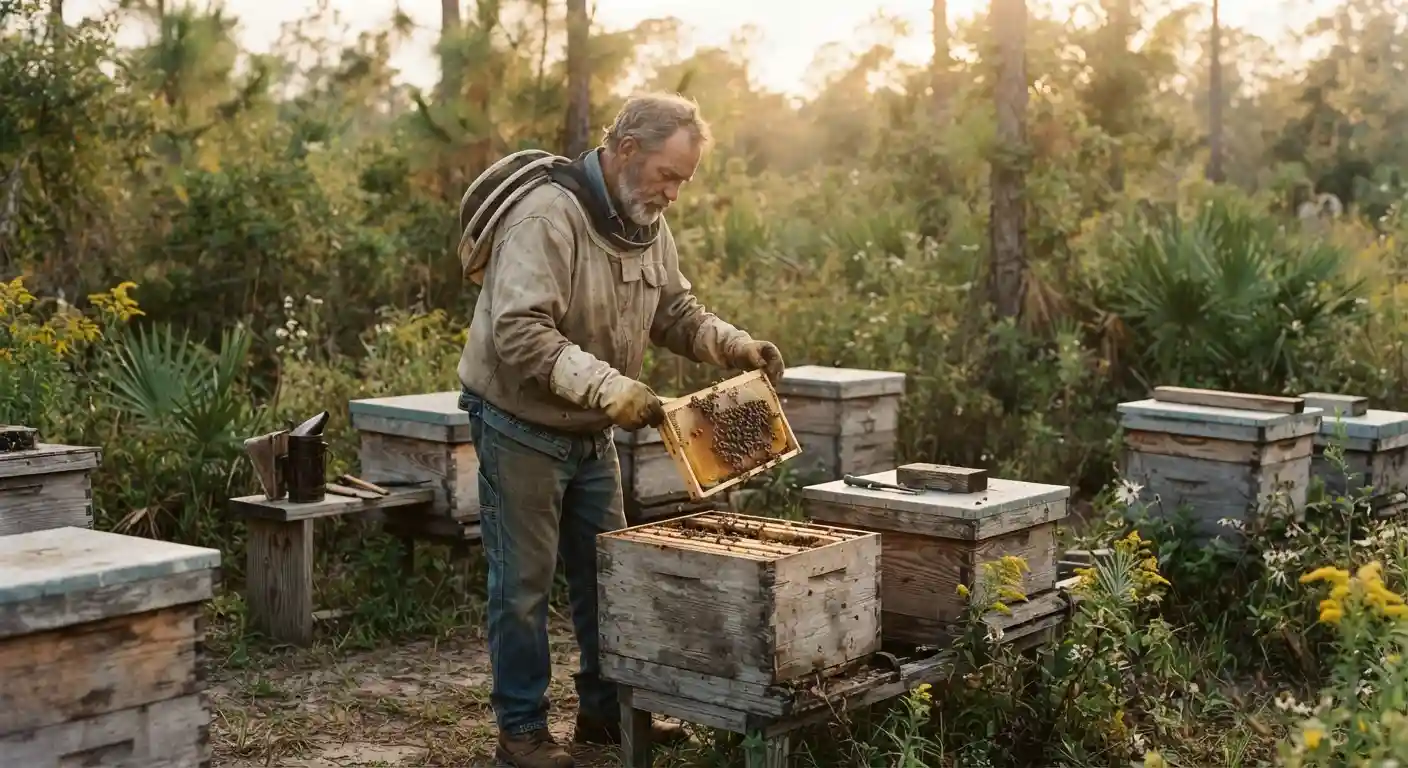
What makes the performance remarkable is not dramatic showmanship. Instead, Fonda builds Ulee through silence, body language, measured dialogue, practical work, and a deep connection to the character’s bees. The result is a restrained performance that gradually reveals a complicated man carrying years of loss and responsibility.
For readers interested in classic American cinema, character-driven dramas, and unusual acting transformations, the Peter Fonda beekeeper role offers plenty to examine. It also helps explain why Ulee’s Gold became one of the most important later-career performances of Fonda’s filmography.
Who Did Peter Fonda Play in Ulee’s Gold?
Peter Fonda played Ulysses “Ulee” Jackson, a widowed beekeeper living in northern Florida. Ulee is a Vietnam veteran and a grandfather trying to keep his family together while continuing to operate his beekeeping business.
His life is deliberately understated. He spends much of his time caring for bees, producing honey, maintaining his property, and looking after his two granddaughters. His son is incarcerated, while serious family problems create additional pressure around the household.
This setup gives Fonda an unusual acting challenge. Ulee is not a character who constantly explains his feelings. Much of what audiences learn about him comes from what he does rather than what he says.
That approach makes the performance particularly interesting when viewed alongside the broader history of entertainment media and film storytelling, where larger-than-life performances often receive more immediate attention than quiet character work.
Why the Beekeeper Role Was So Different for Peter Fonda
Peter Fonda entered popular culture with a very different screen identity. His portrayal of Wyatt, known as Captain America, in Easy Rider helped establish him as a defining figure of the counterculture era.
Ulee Jackson could hardly be more different. He is older, reserved, practical, and deeply connected to a rural way of life. Rather than presenting Fonda as a rebellious young outsider, the film uses his maturity and stillness as essential parts of the character.
The contrast is one reason the role became such an important moment in his career. Instead of relying on the attitude associated with his earlier work, Fonda demonstrates how much emotional information can be communicated through restraint.
That transition is especially valuable for anyone studying the evolution of actors and the entertainment industry. Related discussions about media and entertainment also show how careers can evolve as performers move between different genres, audiences, and creative periods.
How Peter Fonda Created Ulee Jackson
Fonda’s portrayal of Ulee depends heavily on physical behavior. The character has an established routine, and his work around the hives becomes part of his identity.
Instead of treating beekeeping as simple background decoration, the performance makes it feel like an authentic occupation. Ulee understands his bees, works carefully around them, and appears most comfortable when he is engaged with the practical demands of his craft.
This gives the audience a way to understand him without lengthy exposition. His patience with the bees contrasts with the difficulties he experiences in his family life.
Stillness as an Acting Technique
One of the strongest characteristics of Fonda’s performance is stillness. Ulee does not react dramatically to every development. His expressions remain controlled, his voice is generally measured, and his movements feel deliberate.
That restraint does not mean the character lacks emotion. It creates curiosity. Viewers have to pay attention to small changes in his expression, posture, and tone to understand what is happening internally.
Physicality and Routine
Fonda also uses physical behavior to communicate Ulee’s history. His movements suggest a man accustomed to hard work and solitude rather than theatrical performance.
The beekeeper identity therefore becomes more than a profession. It gives the character rhythm, discipline, and a sense of independence. His relationship with his work helps establish the emotional foundation of the film.
The Importance of Beekeeping in Ulee’s Gold
Beekeeping is central to the film’s atmosphere. The bees and honey operation create a calm counterpoint to the conflict surrounding Ulee’s family.
When Ulee is working among the hives, the film becomes observational. The audience sees a man who understands his environment and knows how to perform a demanding task without unnecessary movement.
This makes the profession useful dramatically. The bees represent order and routine, while Ulee’s family life repeatedly introduces uncertainty.
The contrast also makes the story feel grounded in a particular place. Florida is not simply a backdrop; the rural landscape and Ulee’s occupation are connected to his identity.
For readers interested in the region represented in the movie, ThinkRove’s guide to places to visit in Florida provides a broader look at the state’s travel appeal beyond the film’s rural setting.
Peter Fonda’s Understated Performance Style
Fonda’s performance works because he resists the temptation to make Ulee more dramatic than the character needs to be.
His dialogue is often delivered without obvious emotional emphasis. Rather than announcing anger, grief, or fear, Fonda allows those emotions to exist underneath the conversation.
This creates a particularly mature screen presence. Ulee appears to be a man who has experienced enough hardship that he does not need to verbalize every feeling.
The technique is especially effective during family conflicts. Instead of turning every disagreement into a conventional dramatic confrontation, Fonda lets tension build through pauses and controlled reactions.
That approach can be contrasted with the more spectacle-driven side of modern entertainment, where scale and visual excitement often dominate the audience experience.
How Ulee’s Family Story Strengthens the Performance
Ulee is not simply a beekeeper. He is also a father, grandfather, widower, and veteran carrying unresolved personal history.
His relationship with his son is particularly important. The family situation forces Ulee to confront responsibilities he might otherwise prefer to manage quietly.
His granddaughters add another dimension to the character. Ulee is protective, but his approach is not sentimental in a conventional Hollywood sense. His affection is expressed through responsibility and action.
This distinction makes the character feel believable. Ulee is not presented as a perfect grandfather or an uncomplicated hero. He is a tired and determined man attempting to protect the people who depend on him.
Peter Fonda and the Legacy of the Fonda Family
Another important aspect of the performance is its relationship to Peter Fonda’s family legacy.
Peter Fonda was the son of legendary actor Henry Fonda, whose screen image was strongly associated with dignity, restraint, and morally complex characters. Peter’s performance as Ulee naturally invites comparisons with that tradition.
However, the strongest reading of the performance is not simply that Peter was imitating his father. Ulee is clearly his own character, with a distinctive history and emotional world.
The connection becomes interesting because Fonda uses qualities associated with classic American screen acting while bringing his own experience and personality to the role.
For readers exploring the broader cultural background surrounding American cinema and travel, articles such as unusual places to visit in the United States provide another perspective on the landscapes and locations that frequently influence American storytelling.
Why the Role Received Critical Recognition
The performance attracted major critical attention because it demonstrated a different side of Fonda’s abilities. His portrayal was widely recognized as one of the defining achievements of his later career.
Fonda received an Academy Award nomination for Best Actor for the role, placing a restrained independent drama at the center of major awards-season discussion.
He also received a Golden Globe win for his performance, reinforcing the idea that Ulee Jackson was not merely an interesting late-career role but a major acting achievement.
The recognition is notable because the performance does not depend on conventional emotional spectacle. Fonda’s work demonstrates how a quiet character can become memorable through detail and consistency.
What Makes the Performance Memorable?
Several elements combine to make Peter Fonda’s beekeeper role distinctive.
- Restraint: Fonda rarely overplays Ulee’s emotions.
- Physical authenticity: His behavior around the hives supports the character’s profession.
- Emotional complexity: Ulee’s calm exterior hides grief, fear, frustration, and responsibility.
- Character consistency: His personality remains believable throughout the film.
- Career contrast: The role demonstrates how far Fonda had moved from his early counterculture image.
- Sense of place: The Florida environment and beekeeping business are integrated into the character rather than treated as decoration.
Ulee’s Gold as a Character-Driven Film
The movie succeeds partly because its central conflict is built around people rather than spectacle. Ulee’s profession, family, and personal history all contribute to the story’s emotional structure.
That makes the film especially useful for viewers who enjoy character-focused cinema. Instead of moving rapidly from one major event to another, the story gives its central character room to work, observe, think, and respond.
The approach is different from entertainment built around large venues, commercial productions, and major events. ThinkRove’s coverage of entertainment experiences and the entertainment studio environment illustrates how broad the entertainment landscape can be.
The Florida Setting and the Film’s Atmosphere
The northern Florida setting contributes substantially to the mood of Ulee’s Gold. The rural environment gives the story a sense of distance from conventional urban life.
Ulee’s beeyards, home, and surrounding landscape create a world where his occupation feels natural. His relationship with the land reinforces the character’s self-reliant personality.
Florida also provides an interesting connection to travel storytelling. Readers interested in American destinations can explore popular places in America, California destinations, and San Diego attractions to see how different American environments are represented across travel content.
Peter Fonda’s Career Before and After Ulee’s Gold
Before Ulee’s Gold, Fonda had already built a long and unconventional career. His work included counterculture films, westerns, action movies, independent productions, and character roles.
The beekeeper role arrived at a point when his career had already gone through several transformations. That history makes the performance more meaningful because audiences were seeing an established actor redefine what they expected from him.
After Ulee’s Gold, Fonda continued appearing in films across different genres. The role nevertheless remained one of the clearest demonstrations of his ability to carry a deeply internalized character.
His later career can also be considered alongside broader entertainment trends, including the changing relationship between independent cinema, mainstream productions, and modern media coverage.
Why New Viewers Should Still Watch the Performance
Although Ulee’s Gold was released in 1997, Peter Fonda’s performance remains relevant because it demonstrates a form of acting that does not depend on constant dialogue or dramatic gestures.
Viewers interested in acting can study how Fonda communicates through pauses, movement, posture, work routines, and subtle facial changes.
Film fans can also appreciate the performance as an example of a major actor stepping away from a familiar public identity and embracing a quieter character.
For people who enjoy exploring the intersection of cinema, travel, and American culture, related destination stories such as New England travel, New York State destinations, and California in fall can provide useful context for understanding the wide variety of American landscapes represented in film and popular culture.
Final Thoughts on Peter Fonda’s Beekeeper Role
Peter Fonda’s portrayal of Ulysses “Ulee” Jackson remains one of the most compelling examples of his acting range. The role moves away from the rebellious persona associated with his early fame and instead focuses on patience, grief, responsibility, and quiet determination.
The beekeeper profession gives Ulee a practical identity, while his family circumstances expose the emotional difficulties underneath his calm exterior. Fonda brings those two sides together through an understated performance that rewards careful viewing.
Ultimately, the power of the Peter Fonda beekeeper role comes from its simplicity. Ulee does not need grand speeches to communicate what he has endured. His work, silences, routines, and relationships tell the story.
That is why Ulee’s Gold remains an important part of Peter Fonda’s legacy and why his portrayal of a Florida beekeeper continues to stand out among the most distinctive performances of his career.