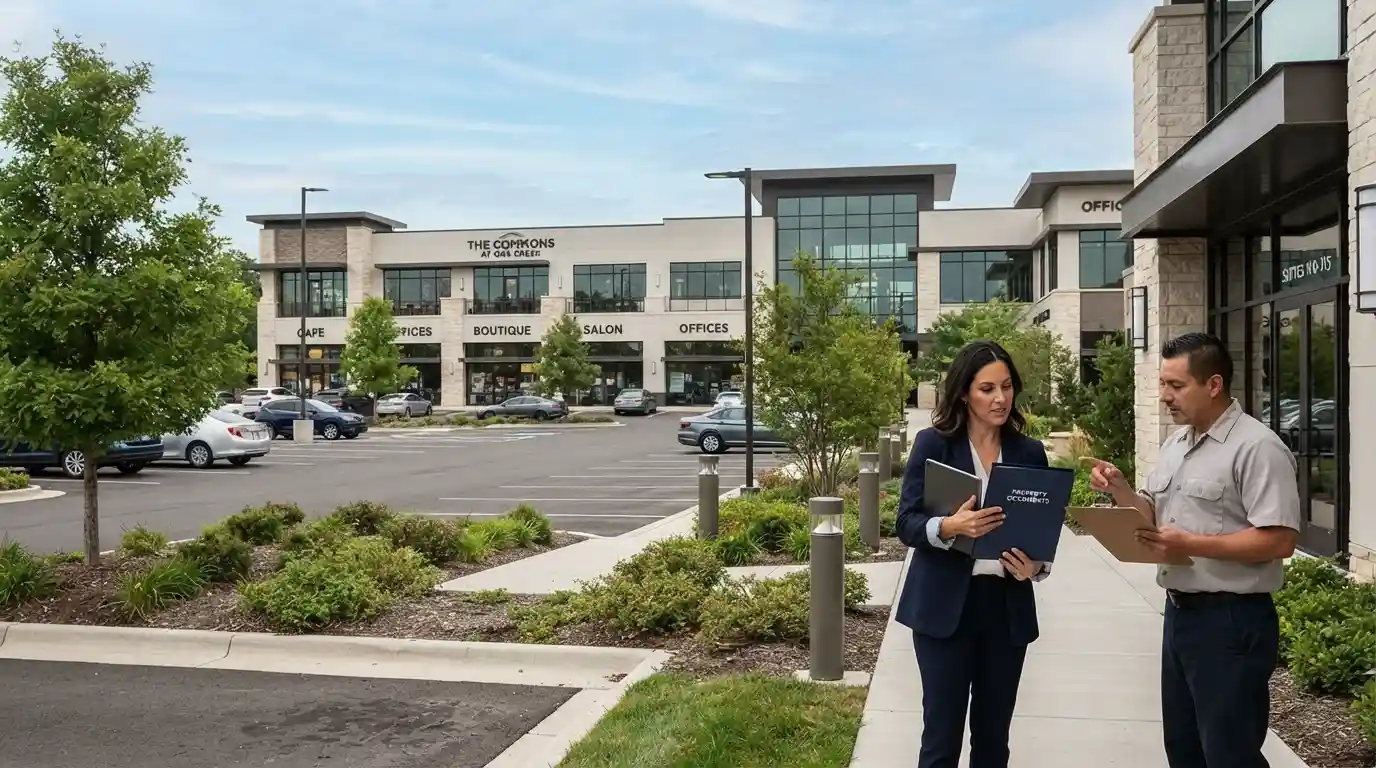
Understanding what CAM means is important for tenants, landlords, property managers, and investors because CAM charges can have a meaningful effect on the total cost of occupying or owning commercial real estate. A property may appear affordable based on base rent alone, but additional operating expenses such as CAM can significantly change the actual financial commitment.
This guide explains the CAM acronym in real estate, what CAM charges commonly include, how they are calculated, why they matter in commercial leases, and what tenants and investors should review before entering into an agreement.
What Does CAM Mean in Real Estate?
In commercial real estate, CAM stands for Common Area Maintenance. It generally refers to expenses required to maintain, repair, operate, and sometimes improve areas of a commercial property that are shared by multiple tenants.
Common areas can include building entrances, hallways, parking areas, landscaping, sidewalks, elevators, lobbies, shared restrooms, and other spaces that serve multiple occupants.
CAM charges are most commonly encountered in commercial leases, particularly retail, office, and industrial properties. Depending on the lease structure, tenants may pay their share of these expenses in addition to base rent and other property-related costs.
For investors evaluating a commercial property, understanding CAM is equally important because these expenses can influence operating income, tenant affordability, lease negotiations, and the overall economics of a property.
Why Is CAM Important in Commercial Real Estate?
CAM matters because the advertised rental rate does not always represent the complete cost of occupying commercial space. A tenant might negotiate an attractive base rent and still face substantial additional expenses through CAM, taxes, insurance, utilities, or other pass-through charges.
For example, imagine a retail tenant agrees to a base rent of $4,000 per month. If the lease also requires the tenant to contribute $800 per month toward common-area expenses, the effective monthly occupancy cost is considerably higher than the base rent suggests.
This distinction is especially important when comparing multiple properties. Two buildings with similar base rents may have very different total occupancy costs because their CAM structures, property expenses, or allocation methods differ.
Investors also need to understand CAM because operating expenses influence the income produced by commercial properties. Careful analysis of these expenses can help investors evaluate whether a property is priced appropriately and whether projected returns are realistic.
What Expenses Are Commonly Included in CAM?
The exact definition of CAM depends on the lease. There is no universal list that applies identically to every commercial property. However, several types of expenses are commonly associated with common-area maintenance.
Landscaping and Grounds Maintenance
Landscaping costs may include lawn maintenance, tree trimming, irrigation, seasonal planting, exterior cleanup, and other services needed to keep shared outdoor areas maintained.
Parking Lot Maintenance
Parking areas can generate expenses related to sweeping, cleaning, lighting, striping, repairs, snow or debris removal, and other maintenance activities.
Common Area Cleaning
Cleaning shared spaces such as lobbies, corridors, entrances, stairways, and restrooms can form part of CAM expenses, depending on the property and lease.
Building Repairs and Maintenance
Routine repairs and maintenance associated with shared portions of a building may also be included. The lease should clarify which repairs are treated as ordinary maintenance and which are considered capital improvements.
Security
Some commercial properties allocate expenses for security personnel, monitoring systems, access control, or other shared security services to tenants.
Utilities for Shared Areas
Electricity, water, lighting, and other utilities used in common areas may be allocated among tenants as part of operating expenses.
Property Management
Depending on the lease structure, property management fees may be included within operating expenses or CAM-related charges. Tenants should review the lease carefully to understand exactly what is being passed through.
CAM vs. Base Rent
Base rent is the primary rental payment specified in a commercial lease. CAM is generally an additional expense associated with maintaining and operating shared portions of the property.
This means a tenant should not automatically assume that a quoted rental rate represents the complete monthly occupancy cost.
A useful way to evaluate a commercial property is to consider:
- Base rent
- CAM charges
- Property taxes
- Insurance
- Utilities
- Other operating expenses
- Potential annual increases
- Tenant-specific expenses
The total cost can then be compared with alternative properties and with the expected revenue generated from the space.
This approach is particularly useful for entrepreneurs and investors researching retail space for lease, because the headline rental rate may not reveal the complete financial picture.
How Are CAM Charges Calculated?
CAM charges are often allocated according to a tenant’s proportionate share of the property. A common approach uses the tenant’s leased square footage compared with the total leasable area of the property.
For example, suppose a shopping center has 50,000 square feet of leasable space and a tenant occupies 5,000 square feet. The tenant’s proportionate share would be 10% under a simple pro-rata calculation.
If eligible CAM expenses for the relevant period total $100,000, the tenant’s share under that basic calculation could be approximately $10,000.
However, real commercial leases can be considerably more complicated. Some agreements contain exclusions, caps, expense pools, management-fee limits, gross-up provisions, or different allocation methods.
Therefore, tenants should never assume that the simple square-footage formula automatically determines their final CAM obligation.
What Is a CAM Reconciliation?
A CAM reconciliation compares estimated payments made by a tenant during a lease period with the property’s actual eligible expenses.
Many landlords collect estimated CAM payments throughout the year. After the accounting period ends, actual expenses can be calculated and compared with the amount already collected.
If actual eligible expenses are higher than the tenant’s estimated payments, the tenant may owe an additional amount. If the tenant paid more than the final calculated share, the lease may provide for a credit or other adjustment.
CAM reconciliation is therefore an important part of understanding the true cost of a commercial lease.
CAM Caps and Expense Limits
Some commercial leases include a CAM cap, which limits how much certain operating expenses can increase during a specified period.
CAM caps can make future occupancy costs more predictable, but the details matter. A cap may apply only to controllable expenses rather than every category of operating cost.
For example, expenses such as property taxes, insurance, utilities, or major uncontrollable costs may be treated differently depending on the lease.
Tenants should therefore determine:
- Which expenses are subject to the cap
- Whether the cap applies annually or over the entire lease term
- Whether unused increases can be carried forward
- Which expenses are excluded from the cap
- How extraordinary expenses are handled
Controllable vs. Uncontrollable CAM Expenses
One of the most important concepts in CAM negotiations is the difference between controllable and uncontrollable expenses.
Controllable expenses are costs that property management may have some ability to manage, such as routine maintenance, landscaping, cleaning, and certain administrative expenses.
Uncontrollable expenses can include costs influenced by external factors, such as property taxes, insurance premiums, utilities, or government-required expenses.
The distinction becomes important when a lease includes annual CAM increases or expense caps. A tenant may negotiate a limit on controllable expenses while accepting that certain uncontrollable costs will remain outside the cap.
CAM in Different Types of Commercial Properties
Retail Properties
CAM is particularly important in shopping centers and retail developments because tenants often benefit from shared parking, landscaping, security, lighting, signage areas, and customer-access infrastructure.
When evaluating retail opportunities, investors and business owners should analyze both rent and operating expenses rather than focusing only on the advertised lease rate.
Office Buildings
Office tenants may contribute toward lobby maintenance, elevators, shared corridors, security, cleaning, landscaping, and other building-wide services.
Premium office buildings can have higher operating expenses because they may provide additional amenities and more intensive property management services.
Industrial Properties
Industrial properties can have CAM obligations associated with shared roads, loading areas, landscaping, security, lighting, and other common infrastructure.
The structure varies considerably between standalone industrial buildings and multi-tenant industrial parks.
CAM and Commercial Real Estate Investment Analysis
CAM is not only a tenant concern. It can also be important when analyzing an investment property.
Investors typically examine income and operating expenses to understand a property’s financial performance. Higher expenses can reduce the property’s net operating income if those expenses are not fully recovered from tenants.
Understanding the relationship between lease terms, operating expenses, and tenant reimbursements can therefore help investors evaluate the stability of a property’s income stream.
This becomes particularly relevant when comparing properties in different markets or evaluating real estate investment opportunities.
Investors researching specialized commercial properties should also understand how local market conditions affect rental rates, operating expenses, tenant demand, and property valuations.
CAM and Net Operating Income
Net operating income, commonly called NOI, is an important measure used in commercial real estate analysis. Operating expenses can directly influence NOI.
However, the effect of CAM depends on how the lease is structured and how expenses are recovered from tenants.
For example, a property with high operating expenses may still produce attractive investment results if its lease structure allows the landlord to recover eligible expenses efficiently. Conversely, unexpected expense increases can negatively affect profitability when they cannot be passed through to tenants.
This is why investors should examine historical operating statements, lease agreements, expense recoveries, and projected expenses instead of relying solely on headline rental income.
CAM and Lease Negotiations
CAM can become an important negotiating point between landlords and tenants.
Before signing a commercial lease, tenants may negotiate provisions concerning expense definitions, caps, exclusions, audit rights, administrative fees, capital expenditures, and reconciliation procedures.
A tenant may also request clearer language regarding what the landlord can and cannot include as a recoverable operating expense.
For businesses considering commercial space, negotiating these provisions can be just as important as negotiating the base rental rate.
Common CAM Lease Issues to Watch For
Commercial leases can contain complex CAM provisions, so several areas deserve careful attention.
Capital Expenditures
Major improvements and capital expenditures should be clearly addressed. A lease may allow certain capital costs to be recovered over time, while other agreements may exclude them from tenant charges.
Administrative Fees
Some leases permit landlords to add administrative or management fees to operating expenses. Tenants should understand how these fees are calculated.
Expense Gross-Ups
In some properties, operating expenses may be adjusted to reflect a hypothetical higher occupancy level. This can affect the amount allocated to tenants, particularly when a building is not fully occupied.
Audit Rights
Some commercial leases provide tenants with rights to review or audit CAM calculations. These provisions can be valuable when operating expenses are substantial.
Duplicate Charges
Tenants should review expense categories carefully to ensure that the same cost is not effectively charged more than once through different components of the lease.
How Tenants Can Review CAM Charges
Tenants should approach CAM review systematically. Start by reading the lease definition of operating expenses and identifying exactly which costs are recoverable.
Next, compare estimated CAM charges with historical statements when available. Look for unusually large changes, new expense categories, or increases that appear inconsistent with the property’s operating history.
It can also be helpful to compare the property’s operating costs with similar commercial properties in the same market.
For businesses evaluating a new location, a complete occupancy-cost analysis should be performed before signing a long-term agreement.
CAM and Real Estate Due Diligence
CAM analysis should form part of broader commercial real estate due diligence. Investors and prospective tenants should examine leases, operating statements, property expenses, tenant obligations, and future capital requirements.
For example, someone researching commercial real estate investment opportunities should consider more than purchase price and rental income. Operating expenses and lease structures can materially affect long-term performance.
Likewise, someone evaluating real estate-related business opportunities may benefit from understanding the broader economics of property ownership and leasing.
CAM vs. Other Commercial Lease Expenses
CAM is only one possible component of a commercial tenant’s occupancy costs. Depending on the lease structure, tenants may also be responsible for property taxes, insurance, utilities, repairs, and other expenses.
Commercial leases are commonly described using structures such as gross leases, modified gross leases, and net leases. In a net lease arrangement, tenants may assume responsibility for certain property expenses in addition to base rent.
The exact obligations depend on the lease language rather than the label alone.
Anyone comparing properties should therefore review the complete expense structure instead of assuming that two properties with identical rental rates have identical costs.
CAM and Real Estate Investment Returns
For investors, the importance of CAM ultimately comes down to cash flow, risk, and property performance.
Predictable and recoverable operating expenses can make a property’s income stream easier to forecast. Uncontrolled expense growth, unclear lease language, or weak reimbursement provisions can introduce additional risk.
This is one reason experienced investors examine lease abstracts and operating statements alongside market rents and property valuations.
For additional context, investors exploring different property-related financial decisions can also review concepts such as commercial property operating costs and broader real estate investment considerations.
Questions to Ask Before Signing a Commercial Lease
Before committing to commercial space, tenants should consider asking:
- What exactly is included in CAM?
- How is my proportionate share calculated?
- Are there annual CAM increases?
- Is there a CAM cap?
- Which expenses are excluded?
- Are capital expenditures included?
- Are management or administrative fees included?
- How often are CAM charges reconciled?
- Do I have audit rights?
- What happens if actual expenses exceed estimates?
- Which expenses are separately billed?
- Can I review historical CAM statements?
Getting clear answers to these questions can reduce surprises and make it easier to compare competing commercial properties.
CAM Acronym Real Estate: Key Takeaways
The CAM acronym in real estate means Common Area Maintenance. It generally describes expenses associated with maintaining and operating shared areas of a commercial property.
CAM can include expenses such as landscaping, parking-area maintenance, cleaning, security, common-area utilities, repairs, and property management, although the exact definition depends on the lease.
For tenants, understanding CAM is essential because it can significantly affect the total cost of occupying commercial space. For landlords and investors, CAM can influence property operating performance, lease economics, cash flow, and investment returns.
The most important lesson is simple: never evaluate a commercial property based only on its advertised base rent. Review the complete lease structure, understand how CAM is calculated, examine expense limitations, and consider how operating costs may change over time.
Whether you are leasing retail space, evaluating an office building, researching an investment property, or comparing commercial opportunities, a clear understanding of CAM can help you make more informed real estate decisions.
Frequently Asked Questions About CAM in Real Estate
What does CAM stand for in real estate?
CAM stands for Common Area Maintenance. It generally refers to expenses related to maintaining and operating shared areas of a commercial property.
Is CAM included in rent?
CAM is often charged separately from base rent, although the exact arrangement depends on the commercial lease. Some lease structures combine certain operating expenses into a broader rental payment.
Who pays CAM charges?
CAM charges are commonly passed on to commercial tenants according to the terms of their lease. The tenant’s share may be calculated using a pro-rata percentage based on leased square footage or another agreed method.
Can CAM charges increase?
Yes. CAM charges can change when eligible property operating expenses increase. Some leases include caps or other limitations on certain categories of expenses.
Can CAM charges be negotiated?
In many commercial lease negotiations, tenants and landlords can negotiate provisions concerning expense definitions, caps, exclusions, audit rights, capital expenditures, and other CAM-related terms.
Why should investors care about CAM?
CAM can affect property operating expenses, tenant affordability, cash flow, and investment performance. Understanding how these costs are structured can provide a clearer picture of a commercial property’s financial potential.