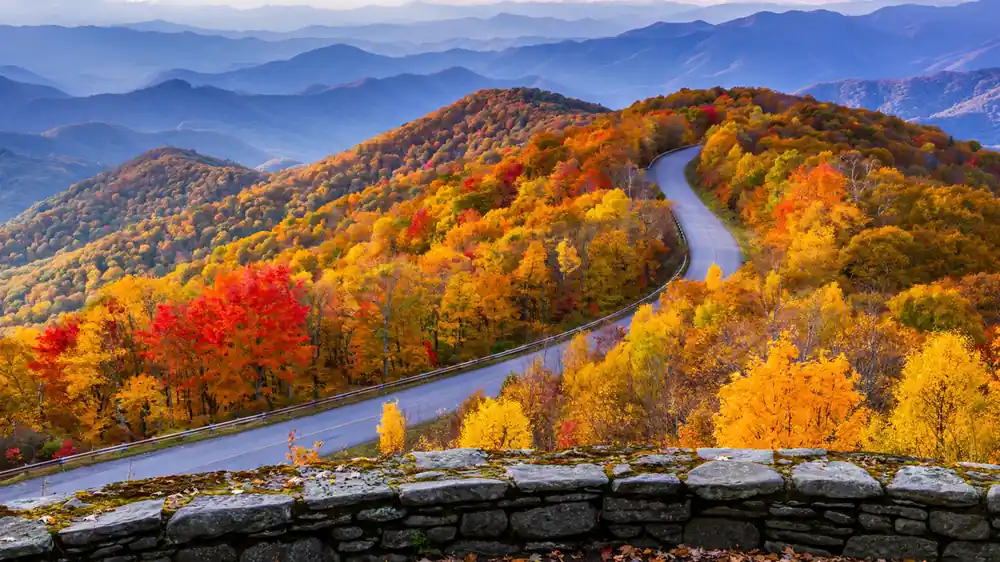
Every October, one road in America turns into a 469-mile art installation. The Blue Ridge Parkway, winding along the crest of the Appalachians from Virginia to North Carolina, hosts the most famous fall foliage drive in the eastern United States — a slow-moving wave of red, orange, and gold that starts on the highest peaks in early October and rolls downhill into November. Get the timing and the stops right, and it is the single best autumn road trip in the country.
This guide gives you the 2026 peak foliage timing by elevation, the ten best stops and overlooks with mileposts, where to base yourself, and the practical tips — traffic, weather, closures — that separate a perfect leaf-peeping weekend from a frustrating one. If you are reading this in late October, the good news is immediate: mid-elevation color is peaking right now, and the lower elevations are just getting started.
Blue Ridge Parkway Fall Foliage 2026: Peak Timing
Forget single “peak day” predictions — on the Parkway, elevation is everything. The road climbs from about 650 feet to over 6,000 feet, and color moves down that gradient over roughly a month. Here is the 2026 timing based on current foliage reports and forestry experts:
Late September to early October: the highest balds above 5,000 feet — Mount Mitchell, Black Balsam, Graveyard Fields — turn first and are now past peak at the very top. October 10–25: the mid-elevation sweet spot (3,000–5,000 feet), which covers most of the famous overlooks — this is peak season for the Linn Cove Viaduct, Craggy Gardens, and the Boone/Blowing Rock area, with Boone itself peaking around October 20. Late October into early November: the lower elevations and valleys — Asheville (peaking around October 26), the French Broad River corridor, and the Virginia sections around Roanoke (peaking around October 29) — are hitting their stride right now and will hold color into early November.
The practical takeaway: if you are driving the Parkway this week, favor the North Carolina sections around Boone, Blowing Rock, and Asheville, and the Virginia sections south of Roanoke. Check a live foliage map and the park’s official closure alerts before you go — sections can close for ice, fog, or storm damage, and detours are part of Parkway life. For more on timing autumn trips generally, our USA road trip planner covers seasonal strategy for the country’s great drives.
The 10 Best Stops for Blue Ridge Parkway Fall Foliage
1. Linn Cove Viaduct (Milepost 304) — the Engineering Marvel
The Linn Cove Viaduct is the most photographed spot on the entire Parkway: a 1,243-foot concrete bridge that snakes around the flank of Grandfather Mountain, seemingly floating above the fall color. The bridge was designed to protect the fragile mountainside below, and in mid-October it hangs suspended over a sea of red and gold. Park at the Linn Cove visitor area and walk the short trail underneath for the classic upward angle, then drive it slowly with the windows down. Peak here typically runs October 10–20 — right in the current window.
2. Grandfather Mountain (Milepost 305, just off the Parkway)
One mile off the Parkway, Grandfather Mountain’s Mile High Swinging Bridge delivers 360-degree views across a dozen ridgelines of color. The mountain’s rugged profile — visible from half the overlooks in the High Country — is the definitive Blue Ridge silhouette. The attraction charges admission and requires reservations on busy fall weekends, so book ahead. Hikers can tackle the Grandfather Trail’s ladders and cables for a serious workout above the color.
3. Craggy Gardens (Milepost 364)
Twenty minutes north of Asheville, the Craggy Gardens area pairs twisted, wind-sculpted beech trees with rhododendron balds and sweeping views back toward the city. The short Craggy Pinnacle trail (0.7 miles) climbs to a 360-degree overlook that is spectacular at sunrise when valley fog pools below the color. This is one of the easiest high-reward stops for Blue Ridge Parkway fall foliage, and the visitor center area makes a natural picnic break.
4. Mount Mitchell (Milepost 355, via NC 128)
At 6,684 feet, Mount Mitchell is the highest peak east of the Mississippi, and its summit observation deck looks out over layer upon layer of blue ridges. The peak’s color turns earliest — usually the first week of October — so by late October the summit may be past peak while the valleys below are just igniting, which makes the view a fascinating study in the season’s progression. The summit is an easy drive-up with a short paved walk, plus a small museum and restaurant at the state park.
5. Graveyard Fields (Milepost 418.8) — the Waterfall Hike
Graveyard Fields pairs two waterfalls with some of the Parkway’s most intense early color. The 3.2-mile loop passes Upper and Lower Falls, with the lower falls framed by crimson maples in mid-October. The valley’s name comes from the tree stumps left by a long-ago fire and windstorm, which early settlers thought looked like gravestones. It is consistently the first high-profile spot to turn each fall, so late-October visitors will find it past peak but still beautiful — and far less crowded than it was two weeks ago.
6. Black Balsam Knob (Milepost 420)
The open grassy bald at Black Balsam offers the Parkway’s most expansive 360-degree panorama — no trees blocking the view in any direction, just rolling waves of color to every horizon. The short climb from the parking area (0.6 miles to the knob) is easy, and the Art Loeb Trail continues along the ridge to Tennent Mountain for hikers who want more. Come at sunset when the grasses turn amber and the ridgelines stack into blue infinity. This is the single best sunset spot for Blue Ridge Parkway fall foliage.
7. Waterrock Knob (Milepost 451.2) — the Southern Overlook
Near the Parkway’s southern end, Waterrock Knob’s observation tower (6,292 feet) delivers the grand finale: views into the Great Smoky Mountains, including Clingmans Dome on clear days. The 0.6-mile trail to the top is steep but short, and the late-October color in the valleys below — around Maggie Valley and Waynesville — is typically at or near peak right now. It is the perfect bookend stop if you are driving the Parkway south to north, or the grand opening if you start here.
8. Mabry Mill (Milepost 176) — the Iconic Photo
In Virginia’s section, Mabry Mill is the most photographed structure on the Parkway: a historic gristmill reflected in its millpond, framed by fall color. Arrive early in the morning for glassy reflections and soft light, and budget time for the short trail around the mill’s outbuildings. The Virginia sections peak later than North Carolina’s — late October into early November — so this stop is perfectly timed for a late-season trip. Pair it with nearby Rocky Knob’s rock scrambles for a fuller day.
9. Peaks of Otter (Milepost 86) — the Lakeside Classic
The Peaks of Otter area centers on Abbott Lake, where Sharp Top and Flat Top mountains reflect in still water ringed by hardwoods. The 3.3-mile Sharp Top hike climbs 1,300 feet to a rocky summit with a 360-degree view — strenuous but short, and the payoff in late October is enormous. The Peaks of Otter Lodge sits right on the lake and books out far ahead for foliage season; reserve months early or day-trip from Roanoke or Bedford.
10. Oconaluftee Valley (Milepost 469) — the Grand Finale
The Parkway’s southern terminus drops into the Oconaluftee Valley at the edge of Great Smoky Mountains National Park, where elk graze in the open fields at dawn and dusk. The Mountain Farm Museum’s historic buildings, the Oconaluftee Visitor Center, and the valley’s golden hardwoods make a gentle, crowd-pleasing finale. If you have another day, continue into the Smokies themselves — our Smoky Mountains guide covers the park side of the equation.
Planning Your Drive: Direction, Bases, and Timing
Most foliage chasers drive sections rather than the whole 469 miles — the speed limit is 45 mph (25 in congested areas), and you will stop constantly. The classic long-weekend plan: base in Boone or Blowing Rock for the High Country (Linn Cove, Grandfather Mountain), then move to Asheville for the central section (Craggy Gardens, Mount Mitchell, Black Balsam), with a final night near Waynesville or Maggie Valley for Waterrock Knob and Oconaluftee. Asheville’s lower elevation (2,134 feet) means its own color peaks around October 26 — later than the ridges above it — so a multi-day stay lets you chase the wave downhill.
Book lodging early: foliage season is the Parkway’s busiest, and the charming inns of Blowing Rock, Asheville, and Little Switzerland fill weeks ahead. Hotel and navigation apps are essential for finding last-minute openings, and first-time USA visitors should note that Parkway campgrounds close in late October — plan accordingly.
Traffic, Weather, and Closures: The Realities
October weekends on the Parkway mean traffic — the overlooks near Asheville and Boone can back up badly between 11 a.m. and 4 p.m. Beat it by driving at sunrise (the light is better anyway) or on weekdays. Weather changes fast with elevation: it can be 65°F in Asheville and 40°F with wind at Black Balsam on the same afternoon, so layer up. Fog is common in the mornings and can close sections temporarily; check the park’s real-time road status before setting out. And fuel up before you get on the Parkway — there are no gas stations on the road itself. Standard road-trip safety habits apply, with extra attention to deer at dawn and dusk.
Photography Tips for Fall Color
The Parkway is forgiving to photographers because the subject does the work — but a few techniques help. Shoot overlooks in the first two hours after sunrise for warm side-light and valley fog; overcast days actually saturate fall color beautifully and eliminate harsh shadows. A polarizing filter cuts haze and deepens the reds; a tripod lets you shoot the waterfalls at Graveyard Fields with silky motion blur. For intimate scenes, get off the overlooks: the forest trails at Craggy Gardens and the millpond at Mabry Mill reward close attention. Our full travel photography guide covers settings for exactly these conditions, and pairing the drive with the Pacific Coast Highway gives you America’s two greatest scenic drives in one year.
Where Else to Chase Fall Color
If the Parkway whets your appetite, the East Coast offers more: New Hampshire’s fall foliage peaks earlier and draws leaf-peepers from around the world, while West Virginia’s fall destinations deliver the central Appalachians’ strongest 2026 color according to the Farmers’ Almanac. And if you are camping your way through foliage season, our beginner camping guide has you covered.
Final Checklist Before You Go
Set yourself up for the perfect drive: live foliage map checked; Parkway closure alerts checked; lodging booked (weeks ahead in October); layers packed for 25-degree elevation swings; full tank of gas before entering the Parkway; sunrise alarm set for the best light and smallest crowds; camera batteries charged. Do that, and the Blue Ridge Parkway fall foliage will do the rest — 469 miles of the finest autumn color in America, peaking right now.
The Parkway crosses the AT repeatedly — see our Appalachian Trail hiking guide for the best nearby day hikes and thru-hike planning.