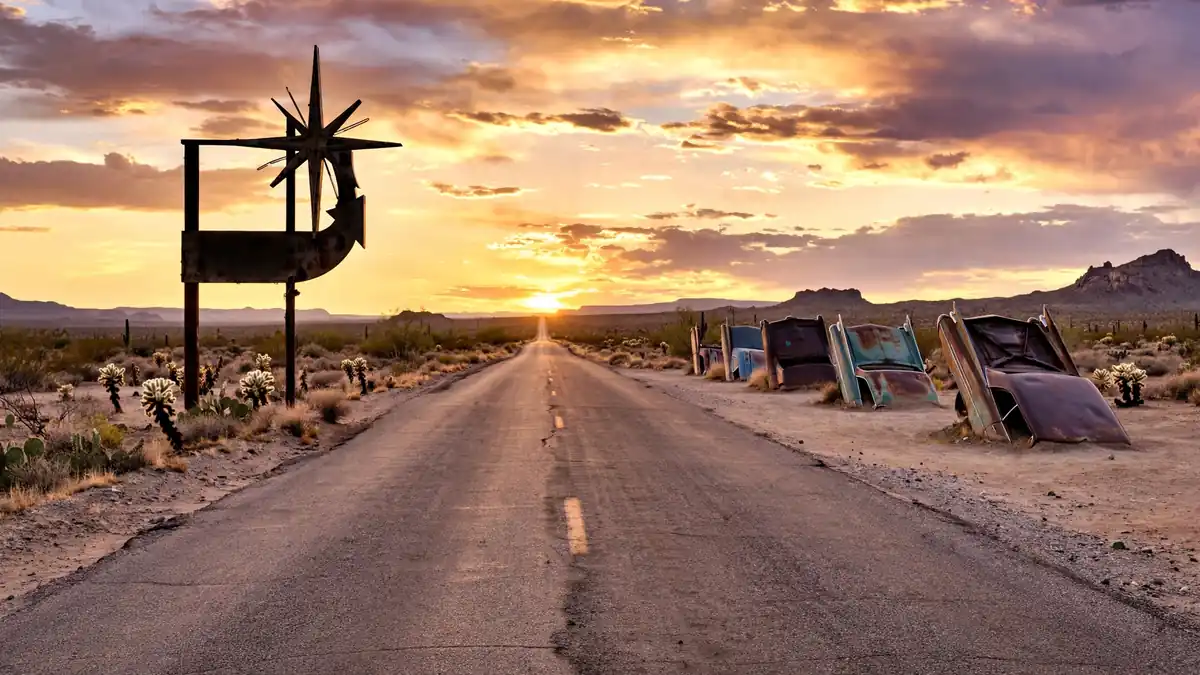
In 2026, America’s most famous highway turns 100 years old — and there has never been a better time to drive it. Route 66, the Mother Road, stretches 2,448 miles from Chicago to Santa Monica, stitching together neon-lit motels, chrome diners, ghost towns, and wide-open desert in one continuous story of 20th-century America. With centennial celebrations running all year and a $5-million-plus restoration sprucing up signs, motels, and attractions to their best condition in decades, the highway is having its biggest moment since the interstate era began.
This Route 66 road trip itinerary breaks the full Chicago-to-Santa-Monica drive into seven manageable days, with the must-see stops, where to eat and sleep, realistic driving distances, and the centennial events worth timing your trip around. Whether you drive the whole Mother Road or cherry-pick a state or two, this plan shows you how to do it right.
Why 2026 Is the Year for a Route 66 Road Trip
Route 66 was officially designated on November 11, 1926, which makes November 11, 2026 its 100th birthday — and the entire year is a rolling celebration. The national kickoff concert in Springfield, Missouri launched the festivities in the spring, and events continue through the fall: car shows, mural festivals, and centennial celebrations in all eight states, culminating in the official birthday in November. Historic properties along the route have been restored with centennial funding, the famous Blue Whale of Catoosa has been spruced up, and even the U.S. Postal Service is issuing commemorative stamps. An estimated 2–3 million visitors are expected on the route this year — roughly double a normal year — so book lodging early, especially for the fall centennial events.
The road itself is the attraction. Decommissioned as a federal highway in 1985 and replaced by interstates, Route 66 survives as a patchwork of historic alignments, frontage roads, and lovingly preserved two-lane stretches through Illinois, Missouri, Kansas, Oklahoma, Texas, New Mexico, Arizona, and California. Driving it is not about speed — the interstates do that — it is about the journey: small towns, neon signs flickering on at dusk, pie at a counter that hasn’t changed since 1952. If you love classic American road trips, our USA road trip planner ranks the Mother Road among the country’s essential drives.
Planning Basics: Direction, Duration, and Budget
Most travelers drive east to west, Chicago to Santa Monica, following the historic migration narrative — but the road works fine in either direction. Seven days is the minimum for the full route at a satisfying pace (about 350 miles of driving per day plus stops); ten to fourteen days lets you linger. Budget roughly $150–200 per person per day covering motels, diners, gas, and attractions — the Route 66 road trip remains one of America’s most affordable great journeys because the classic motels and diners are priced for regular folks, not tourists.
The best seasons are spring (April–May) and fall (September–October), when the desert is mild and the plains are green. Summer brings brutal heat to the Mojave and monsoon storms to the Southwest; winter can ice the high plains and the Arizona mountains. For 2026 specifically, fall is the sweet spot: pleasant weather plus the run-up to the November centennial. Flying into Chicago or out of Los Angeles? These flight tips can cut your airfare significantly, and first-time USA visitors should sort rental-car and insurance details before landing.
Your 7-Day Route 66 Road Trip Itinerary
Days 1–2: Chicago, Illinois to St. Louis, Missouri (300 miles)
Begin at the official start sign on Adams Street in downtown Chicago — the photo is mandatory. Illinois gives you nearly 300 miles of classic Americana: the Gemini Giant in Wilmington, the Route 66 Hall of Fame in Pontiac, and Springfield’s Cozy Dog Drive-In, birthplace of the corn dog on a stick (1946, and the same family still runs it). Cross into Missouri for St. Louis, where the Gateway Arch marks the symbolic halfway point of America’s westward story. Sleep in a restored motor court if you can — the Wagon Wheel Motel in Cuba, Missouri (1930s, still operating) is the Route 66 lodging experience in miniature. Illinois packs more original roadside architecture per mile than any other state, so don’t rush this stretch.
Day 3: St. Louis to Tulsa, Oklahoma (400 miles)
Missouri’s Ozark stretch serves up the route’s best caverns (Meramec Caverns, a longtime 66 billboard legend) and the world’s largest rocking chair in Fanning. Clip the 13-mile Kansas segment — the shortest of any state, but don’t skip the Cars on the Route diner in Galena, inspiration for Pixar’s Cars. Oklahoma is where the Mother Road feeling deepens: Tulsa’s art-deco downtown, the Blue Whale of Catoosa (freshly restored for the centennial), and the Route 66 Museum in Clinton, the single best museum of the highway’s history anywhere. End the day in Oklahoma City or push to the Texas line.
Day 4: Oklahoma City to Amarillo, Texas (260 miles)
Western Oklahoma gives you the leaning water tower of Britten and the wide-open prairie the Dust Bowl migrants crossed. Cross into the Texas Panhandle for the Cadillac Ranch outside Amarillo — ten Cadillacs nose-down in a wheat field, covered in spray paint, and one of the most interactive art installations in America (bring your own paint). Amarillo’s Route 66 Historic District hosts the year’s Texas centennial events, and the Big Texan Steak Ranch (home of the 72-ounce steak challenge) is pure roadside theater. Texas owns only 178 miles of the route but packs them with icons.
Day 5: Amarillo to Albuquerque, New Mexico (290 miles)
Tucumcari’s neon motel signs — the Blue Swallow (1942, lovingly restored) is the crown jewel — light up this stretch at dusk, so time your arrival accordingly. Cross into New Mexico, the Land of Enchantment, where the route’s pre-1937 alignment loops north through Santa Fe (worth the detour for adobe architecture and green chile everything) before rejoining at Albuquerque. Albuquerque’s Central Avenue is one of the best-preserved urban 66 strips in America, and the city’s centennial events have drawn visitors all year. New Mexico’s 400-plus miles hold the route’s most dramatic desert-mountain scenery.
Day 6: Albuquerque to Flagstaff, Arizona (320 miles)
Gallup’s trading posts, the Continental Divide crossing, and then Arizona — which claims the longest intact stretch of original 66 in America, 159 miles from Seligman to the California border. Stand on the corner in Winslow, Arizona (yes, the Eagles song — there’s a statue and a flatbed Ford), explore the Petrified Forest’s painted desert (a short detour south), and overnight in Flagstaff, the mountain town that anchors this section. The Seligman-to-Oatman stretch is the route’s wildest driving: narrow, winding, and gloriously frozen in time, with wild burros wandering Oatman’s main street.
Day 7: Flagstaff to Santa Monica, California (470 miles)
The final push crosses the Mojave: the ghost town of Amboy (Roy’s Motel sign, restored for the centennial), the bottle-tree ranch of Oro Grande, and Barstow’s Harvey House. Then Los Angeles, where the route threads through Pasadena and Hollywood before ending at the Santa Monica Pier — touch the “End of the Trail” sign, dip your toes in the Pacific, and you’ve completed the most storied drive in America. Keep going up the coast if you have extra days; the Pacific Coast Highway is the natural sequel to a Route 66 road trip.
Where to Eat: Diners Worth Planning Around
The food is half the experience. Non-negotiable stops: Lou Mitchell’s in Chicago (breakfast since 1923, at the route’s start), the Cozy Dog in Springfield, Ted Drewes frozen custard in St. Louis, the Rock Cafe in Stroud, Oklahoma (rebuilt after a 2008 fire, still serving), the Big Texan in Amarillo, the 66 Diner in Albuquerque, Mr. D’z Route 66 Diner in Kingman, and the Apple Pan in Los Angeles near the route’s end. Eat pie wherever pie is offered — the meringues at the Midpoint Cafe in Adrian, Texas (the exact midpoint of the route) are legendary. Budget travelers: diner breakfasts are huge and cheap, making them the best value meal on the road. More budget road-trip tactics here.
Where to Sleep: Motels, Wigwams, and Motor Courts
Skip the chains and sleep in the history. The essential overnights: the Blue Swallow Motel in Tucumcari (neon, garages, 1940s charm), the Wigwam Motels in Holbrook, Arizona and San Bernardino, California (concrete teepees you sleep in), the Wagon Wheel in Cuba, Missouri, La Posada in Winslow (a restored 1930 Harvey House hotel, worth the splurge), and the El Rancho in Gallup (Hollywood’s old western-film headquarters). Book the famous ones weeks ahead in 2026 — centennial crowds are real. Between icons, clean independent motels run $70–110 a night along most of the route.
Centennial Events Worth Timing Around
If your dates are flexible, anchor them to the 2026 celebrations. The spring kickoff in Springfield, Missouri drew the national spotlight; summer brought the Texas Route 66 Festival in Amarillo and car shows across the route; fall features mural festivals and the Miles of Possibility conference in Springfield, Illinois; and November 11 itself — the exact 100th anniversary — brings simultaneous celebrations across all eight states, from the Route 66 State Park gathering in Missouri to events in Tucumcari, Flagstaff, and Santa Monica. Even if you miss the big dates, centennial exhibits, restored signage, and special programming run all year at museums and visitor centers along the route.
Practical Tips for the Drive
Navigation: the route is not one continuous road anymore — download the EZ66 Guide (the bible of 66 navigation, updated for the centennial) and a good offline maps app, because signage gaps are part of the adventure. Car: any reliable vehicle works; convertibles are glorious in the desert spring. Gas: fill up whenever you are below half a tank in the western stretches — services thin out between towns. Safety: the route is as safe as any American road trip, but standard road-trip safety habits apply, especially on remote desert alignments. Photography: neon signs photograph best at blue hour, and these shooting tips will level up your roadside shots.
Extending Your Trip
Route 66 connects to everything. Detour north to America’s busiest destinations, south to the Grand Canyon from Flagstaff, or west up the coast on the Pacific Coast Highway. Adrenaline seekers can add the country’s top adventure experiences at stops along the way. The Mother Road is a beginning, not an end.
Final Checklist Before You Go
Set yourself up right: EZ66 Guide or equivalent turn-by-turn directions downloaded; lodging booked (especially the iconic motels); rental car confirmed with unlimited miles if needed; a cooler for desert stretches; a real camera for the neon; cash for small-town diners that still prefer it; and someone at home with your rough itinerary. Do that, and your Route 66 road trip will deliver exactly what a century of travelers have found on the Mother Road — the real America, one neon sign at a time.