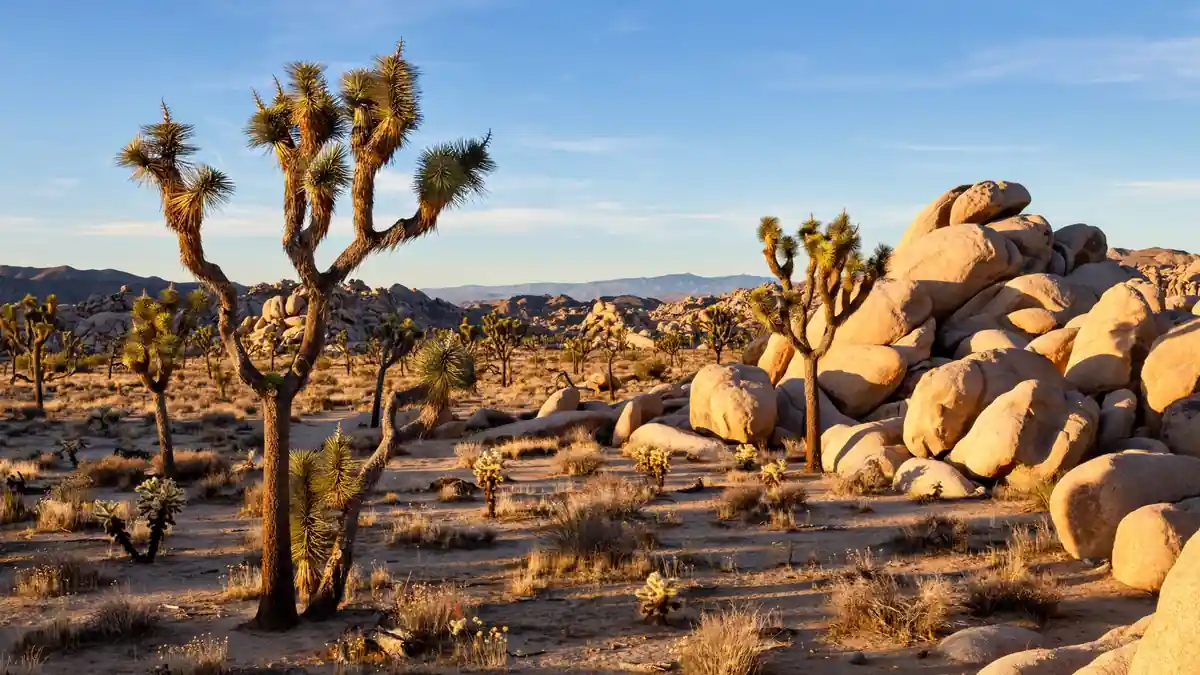
There is nowhere else in America that looks like Joshua Tree. Twisted, Dr. Seuss-like trees stand guard over piles of honey-colored boulders, and at night the sky erupts with more stars than most Americans have ever seen in their lives. The park sits where the Mojave and Colorado deserts collide, which means every hike serves up two deserts’ worth of scenery — spiky yucca forests on one side, open cactus-dotted plains on the other.
This guide covers the seven best Joshua Tree hikes for first-time visitors, from easy nature loops you can knock out before lunch to the park’s signature summit climb. You will find honest distances, difficulty ratings, the desert safety rules that matter, current fee information, and exactly when to visit to dodge the brutal summer heat.
Why Joshua Tree Hikes Are Unlike Anywhere Else in America
Joshua Tree National Park protects 790,000 acres of California desert about two hours east of Los Angeles, and its fame has exploded over the past decade — the park now draws over 3 million visitors a year. The namesake Joshua tree is not actually a tree at all but a giant yucca, and it grows only in the Mojave Desert, which makes this landscape genuinely irreplaceable. Add world-class rock climbing on the park’s monzogranite boulders, some of the darkest night skies in Southern California, and spring wildflower blooms that carpet the desert floor, and you get a park that rewards hikers, climbers, photographers, and stargazers in equal measure.
The park’s two-desert split shapes every visit. The higher, cooler Mojave side in the west holds the Joshua tree forests and the famous rock piles; the lower, hotter Colorado Desert side in the east centers on the Cholla Cactus Garden and vast open washes. Smart visitors plan their Joshua Tree hikes around this geography — and around the sun, which is the real trail boss here. For perspective on how the park fits into the country’s great trails, see our roundup of America’s best hiking trails.
Planning Your Visit: Fees, Seasons, and Desert Rules
The private-vehicle entrance pass costs $30, valid for seven days, and the America the Beautiful annual pass ($80 for US residents) covers it. Joshua Tree does not require timed-entry reservations — you can roll up to the gate any time, though entrance stations back up badly on winter weekends and holidays, so arrive before 10 a.m. or enter via the less-used south (Cottonwood) entrance.
Season is everything in the desert. October through April is prime hiking season, with daytime highs in the 60s and 70s and gloriously clear skies. May and September are workable if you start at dawn; June through August, with highs routinely over 100°F, is genuinely dangerous for hiking and best avoided. Winter nights drop near freezing, so pack layers even when the afternoon feels like spring. After good winter rains, the spring wildflower bloom — typically March into April — is one of the great natural spectacles in the American West.
Desert hiking has non-negotiable rules. Carry at least one gallon of water per person per day — there is no water available anywhere in the park except at a few trailhead-adjacent visitor areas, and none on the trails themselves. Tell someone your plan, because cell service is spotty to nonexistent across most of the park. And respect the heat: heat exhaustion sneaks up fast when the air is dry. Our adventure safety guide covers the full desert protocol, from sun protection to what to do if you get lost.
The 7 Best Joshua Tree Hikes
1. Hidden Valley Nature Trail — the Rock-Scrambling Intro
Distance: 1-mile loop · Elevation gain: 100 feet · Difficulty: easy · Best season: October–April
This one-mile loop is the perfect first taste of the park. It winds through a hidden valley enclosed by towering rock walls, passing the boulders that made Joshua Tree a climbing mecca and offering easy, optional scrambles for the sure-footed. Interpretive signs explain the geology and the valley’s history as a hideout for 19th-century cattle rustlers. Go at golden hour when the rocks glow amber, and you will understand the hype immediately. The trailhead parking fills by mid-morning on weekends — arrive early.
2. Ryan Mountain Trail — the Signature Summit
Distance: 3 miles round trip · Elevation gain: 1,050 feet · Difficulty: moderate · Best season: October–April
Ryan Mountain is the classic Joshua Tree summit hike and the best panoramic viewpoint in the park. The trail climbs steadily — no scrambling, just a solid stair-stepper workout — to a 5,457-foot peak with 360-degree views over the Wonderland of Rocks, the Pinto Basin, and on clear days, Mount San Jacinto and Mount San Gorgonio. Start at sunrise for the best light and the emptiest trail. There is zero shade on this hike, so carry more water than feels reasonable and wear a hat. It is the single most rewarding of the Joshua Tree hikes on this list for the effort involved.
3. Skull Rock Nature Trail — the Roadside Wonder
Distance: 1.7-mile loop · Elevation gain: 150 feet · Difficulty: easy · Best season: year-round (mornings best)
A giant boulder eroded into the shape of a human skull sits right beside Park Boulevard, and the nature trail loop around it passes a field of equally strange rock formations. It is short, easy, and endlessly entertaining for kids — the kind of stop that breaks up a driving day perfectly. Walk it early in the morning before the tour buses arrive, and take the short spur to the rock “face” for the classic photo. Combine it with the nearby Split Rock loop (2 miles) for a fuller morning.
4. Arch Rock Nature Trail — the Sunset Spot
Distance: 1.2 miles round trip · Elevation gain: 100 feet · Difficulty: easy · Best season: October–April
Tucked in the White Tank Campground area, this short trail leads to a delicate natural arch framed by boulders — and at sunset, the light pours through it in a way that makes photographers lose their minds. The trail is sandy and easy to follow, winding past some of the park’s most photogenic rock piles. Stay after sunset if the sky is clear: this area has minimal light pollution, and the stars come out in force. It is one of the finest sunset Joshua Tree hikes for visitors who don’t want a workout with their view.
5. Cholla Cactus Garden Nature Trail — the Other Desert
Distance: 0.25-mile loop · Elevation gain: none · Difficulty: easy · Best season: October–April
On the park’s Colorado Desert side, thousands of teddy-bear cholla cacti pack a quarter-mile loop with otherworldly density. At sunrise and sunset the backlit spines glow like fiber optics — it is genuinely one of the strangest and most beautiful short walks in any American national park. Stay on the trail and do not touch the cacti: the “jumping” cholla nickname exists because segments detach at the slightest brush and the barbed spines are miserable to remove. Carry tweezers in your first-aid kit just in case. This is the essential stop on the park’s east side and pairs perfectly with a drive through the Pinto Basin.
6. Barker Dam Nature Trail — the Desert Oasis
Distance: 1.1-mile loop · Elevation gain: 100 feet · Difficulty: easy · Best season: October–April
Built by 19th-century cattle ranchers, Barker Dam holds water through much of the year, attracting bighorn sheep, coyotes, and dozens of bird species — a genuine oasis in the rock piles. The loop trail also passes Native American petroglyphs and some of the park’s best boulder scenery. Early morning is prime wildlife time; bring binoculars. After winter rains the dam overflows and the reflections double the scenery. It is an easy, shaded-in-spots walk that shows a completely different side of the desert from the cactus gardens.
7. Warren Peak via Black Rock Canyon — the Quiet Climb
Distance: 6 miles round trip · Elevation gain: 1,100 feet · Difficulty: moderate to hard · Best season: October–April
Most visitors never find the park’s northwest corner, which is exactly why Warren Peak is special. Starting at the Black Rock Canyon trailhead, the trail climbs through pinyon-juniper woodland and Joshua tree forest to a 5,103-foot summit with sweeping views over the Coachella Valley and, on the clearest days, the Salton Sea. You will likely share the summit with nobody. The trailhead also accesses the Black Rock Campground, one of the park’s best base camps, with water and flush toilets — a rarity in Joshua Tree. This is the locals’ favorite among Joshua Tree hikes, and the solitude is the point.
Where to Stay: Camping and Nearby Towns
Joshua Tree’s campgrounds are the experience — sleeping among the boulders under that sky is half the trip. Jumbo Rocks and Hidden Valley put you in the heart of the rock piles; Black Rock has water and is best for families; all reservable sites book out months ahead for the October–April season via Recreation.gov, so reserve early. If campgrounds are full, the gateway towns of Joshua Tree, Yucca Valley, and Twentynine Palms offer everything from vintage motels to design-forward Airbnbs. Palm Springs, 45 minutes south, works as a comfortable base if you want resort amenities. New to sleeping outdoors? Start with our beginner camping guide before you commit to a desert night.
Desert Safety: The Rules That Keep You Alive
Desert hiking punishes the unprepared, so take this section seriously. Water: one gallon per person per day, minimum, plus extra in the car — there is no water on the trails. Heat: hike before 10 a.m. and after 4 p.m. in the warmer months, rest in shade during midday, and learn the symptoms of heat exhaustion (headache, nausea, dizziness mean stop immediately). Navigation: download offline trail maps before you enter the park; the rock piles all look alike and it is embarrassingly easy to get turned around. Wildlife: rattlesnakes are active in warm months — watch where you put hands and feet around rocks. None of this is meant to scare you off; millions hike here safely every year by following exactly these rules.
Stargazing in Joshua Tree
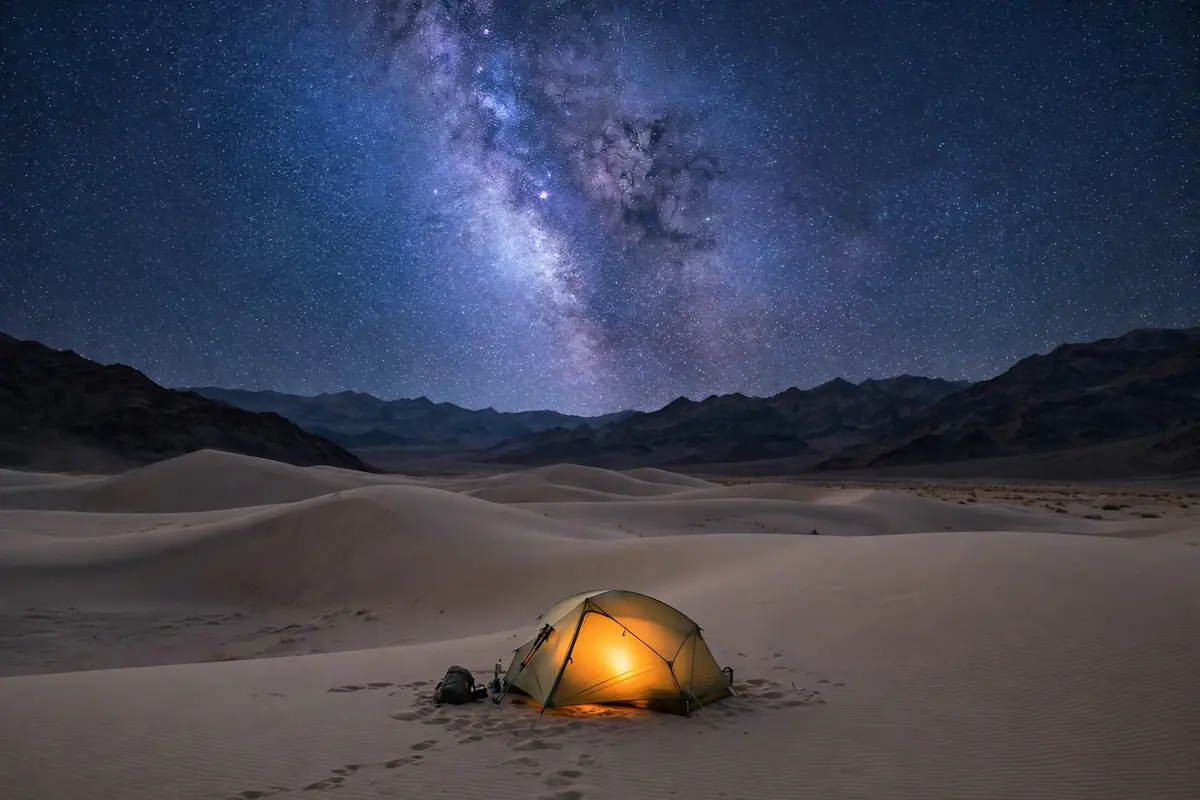
Joshua Tree is an International Dark Sky Park, and on a moonless night the Milky Way is bright enough to cast shadows. The best stargazing spots are Arch Rock, the Cholla Cactus Garden, and anywhere along the Pinto Basin Road away from the west entrances. Check the moon phase before your trip — the week around the new moon is prime. Bring a red-light headlamp to preserve your night vision, a warm jacket (desert nights are cold even in spring), and patience: your eyes need 20–30 minutes to fully adapt. Photographers should read our night-sky shooting tips before attempting Milky Way shots over the rock piles.
Pairing Joshua Tree With a Southern California Trip
Joshua Tree sits within easy reach of an epic Southern California loop. Combine it with California’s best fall destinations, the Palm Springs desert resorts, or a run up the coast — and if you are heading east afterward, Arizona’s winter destinations pair perfectly with a desert itinerary. Hikers hungry for red rock after the desert can head for Zion’s canyon trails or the turquoise waterfalls of Havasu. Doing the whole region on a budget? These budget adventure tips keep a multi-park road trip affordable.
Final Checklist Before You Go
The desert rewards preparation: one gallon of water per person per day; sun protection (hat, sunscreen, sunglasses); offline maps downloaded; campground reserved months ahead for peak season; moon phase checked if you want stars; wildflower reports checked for a spring trip; someone knows your hiking plan. Pack like that, and the best Joshua Tree hikes will deliver exactly what the park promises — strange trees, glowing rocks, enormous skies, and the particular silence you only get in the desert.
Combine this with camping in Death Valley for the ultimate California desert doubleheader.