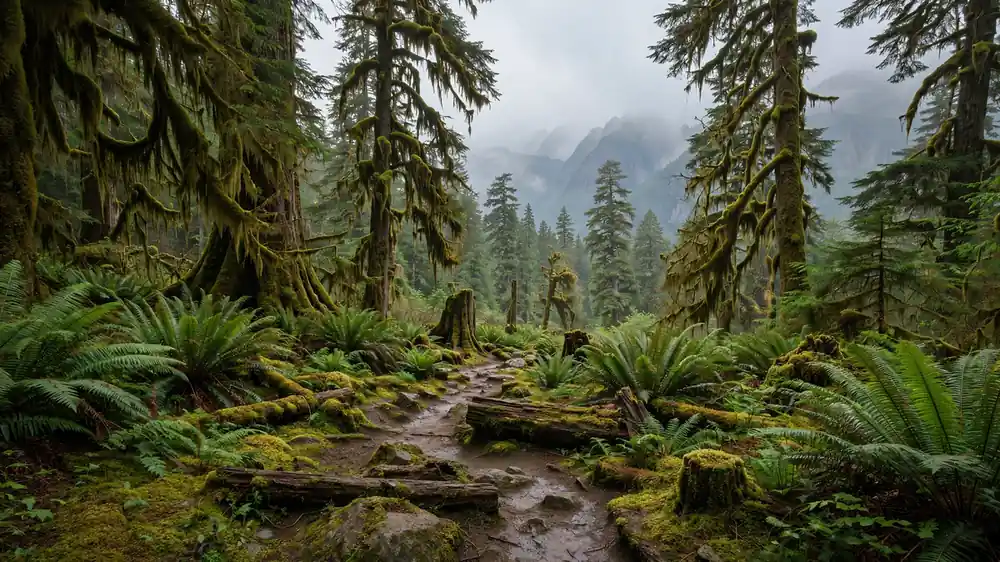
Few national parks pack as much variety into one boundary as Olympic. In a single weekend you can walk beneath moss-draped giants in one of the only temperate rainforests in the lower 48, watch the sun drop into the Pacific from a driftwood-strewn beach, and stand on a windswept ridge staring at glacier-capped peaks. That variety is why choosing the best Olympic National Park hikes matters: the park is huge and spread across three regions, and the wrong trail choice can cost you a full day of driving.
This guide narrows it down to the seven best Olympic National Park hikes for first-time visitors, mixing easy walks with real leg-burners. You will get honest distances, elevation gain, difficulty ratings, the best season for each trail, and the practical details — entrance fees and tide charts — that separate a great trip from a miserable one.
Why Olympic National Park Hikes Belong on Every Hiker’s Bucket List
Olympic National Park protects nearly a million acres on Washington’s Olympic Peninsula under three completely different ecosystems — something almost no other park manages. Glaciated peaks rise at the center, the Hoh and Quinault rainforests wrap the western slopes, and more than 70 miles of wild Pacific coastline guard the west. About 95 percent of the park is designated wilderness, so the trails feel genuinely remote even when the trailhead lot is full.
The diversity shows up in the numbers. Olympic holds the largest herd of Roosevelt elk in the Pacific Northwest, some of the oldest living trees in the country, and beaches where sea stacks rise out of the surf like stone cathedrals. For hikers, the payoff is simple: few American trails reward every mile walked the way Olympic’s do.
Planning Your Trip: Fees, Seasons, and Logistics
Before you lace up, sort out the basics. The private-vehicle entrance pass costs $30 and is valid for seven days; the America the Beautiful annual pass ($80 for US residents) covers it and every other national park. Olympic does not use timed-entry reservations, so once you have your pass you can drive in whenever you like — a real advantage over parks that make you book months ahead.
Timing matters more here than at most parks because the three regions peak at different times. Hurricane Ridge and the high country are generally snow-free from late June through September, with wildflowers best in late July and August. The rainforests and beaches are hikeable year-round — the Hoh in winter is moody and crowd-free, though you should expect rain. Fall brings salmon runs and the first big Pacific storms, which draw storm-watchers to the coast from October onward.
One more planning reality: Olympic is not a drive-through park. Port Angeles anchors the north side, Forks the west, and getting between regions means long drives on two-lane roads with no shortcuts. Most visitors base themselves in Port Angeles for the mountains and Forks for the rainforest, treating the coast as its own day. If you are new to planning big park trips, our first-timer’s USA travel guide covers the logistics habits that keep multi-region trips running smoothly.
The 7 Best Olympic National Park Hikes
1. Hall of Mosses Trail — the Rainforest Classic
Distance: 0.8 miles round trip · Elevation gain: minimal · Difficulty: easy · Best season: year-round
If you hike exactly one trail in Olympic, make it this one. The Hall of Mosses loop in the Hoh Rainforest is less than a mile of flat, boardwalk-and-dirt trail, and it delivers the single most otherworldly landscape in the park. Bigleaf maples wear curtains of clubmoss so thick the branches disappear, Sitka spruce rise 250 feet into a green gloom, and the light filters down in shafts that photographers dream about. Arrive before 9 a.m. or after 4 p.m. to dodge the midday crowds, and bring rain gear even in August — the Hoh gets up to 14 feet of rain a year. This is the easiest of all the Olympic National Park hikes on this list, and it is wheelchair-accessible.
2. Sol Duc Falls Trail — the Waterfall Walk
Distance: 1.6 miles round trip · Elevation gain: 200 feet · Difficulty: easy · Best season: late spring through fall
The Sol Duc River pours over a cliff into a narrow canyon, and the viewing bridge at the falls puts you close enough to feel the spray. The trail winds through old-growth forest of Douglas fir and western hemlock, crossing the river on sturdy bridges. Go in late May or June when snowmelt swells the falls to their most dramatic, or in October when the bigleaf maples turn gold. Pair it with a soak at the Sol Duc Hot Springs Resort mineral pools afterward — your legs will thank you. The trailhead sits at the end of Sol Duc Road, which typically opens in late spring depending on snow.
3. Hurricane Hill Trail — the Ridge Walk
Distance: 3.4 miles round trip · Elevation gain: 650 feet · Difficulty: easy to moderate · Best season: late June through October
Starting from the Hurricane Ridge visitor center (5,242 feet), this is the best effort-to-view ratio in the park. The trail rolls along an open alpine ridge with Mount Olympus and its glaciers to the south and the Strait of Juan de Fuca to the north. In July and August the meadows explode with lupine and paintbrush while black-tailed deer graze fearlessly nearby. Watch for marmots whistling from the rocks. The trail itself is a summer hike — snow lingers into July in heavy years. Sunset up here, with the Olympics turning pink behind you, is one of the great free shows in American hiking.
4. Mount Storm King — the Rope-Assisted Climb
Distance: 4 miles round trip · Elevation gain: 2,000 feet · Difficulty: hard · Best season: late June through October
For hikers who want a genuine challenge, Storm King is the one. The trail starts at the Marymere Falls trailhead near Lake Crescent and climbs relentlessly through forest before the maintained trail ends — and the real fun begins. From there, an unmaintained scramble with fixed ropes climbs the exposed rocky summit ridge to a viewpoint staring straight down at Lake Crescent’s impossible blue water 2,000 feet below. This is not a trail for beginners, anyone afraid of heights, or wet days; the ropes are an aid, not a guarantee. Wear gloves, bring more water than you think you need, and start early to beat the afternoon heat on the exposed rock. The payoff is the single best summit view among Olympic National Park hikes that a strong day-hiker can reach.
5. Ruby Beach and the Coastal Trail — the Wild Pacific
Distance: 1–3 miles round trip (your choice) · Elevation gain: 100 feet · Difficulty: easy · Best season: year-round
Ruby Beach is the postcard — sea stacks rising from the surf, driftwood logs the size of telephone poles, and at low tide, tide pools full of starfish and anemones. The short trail drops from the parking area to the beach, and from there you can walk the shoreline north as far as your legs and the tide allow. That last part matters: coastal hiking in Olympic is governed by the tide chart, not your watch. Check the tide tables before you go, never get trapped between a headland and a rising tide, and keep a healthy distance from sneaker waves. Winter storm-watching from the overlook (no beach walk needed) is spectacular from November through February.
6. Hoh River Trail to Five Mile Island — the Deep Forest Immersion
Distance: 10.6 miles round trip · Elevation gain: 300 feet · Difficulty: moderate · Best season: year-round (best May–October)
Want to go deeper than the Hall of Mosses crowds? The Hoh River Trail follows the milky, glacier-fed river upstream through rainforest that gets wilder and quieter with every mile. Five Mile Island makes a perfect turnaround for a long day hike, with massive spruce, nurse logs sprouting rows of saplings, and a very real chance of spotting Roosevelt elk. Carry offline trail maps — there is no cell service in the Hoh valley — and review backcountry safety basics before any hike over five miles.
7. Shi Shi Beach and Point of the Arches — the Overnight-Worthy Coast
Distance: 8.8 miles round trip · Elevation gain: 200 feet · Difficulty: moderate · Best season: May through September
On the remote northwest tip of the peninsula, in the Makah Reservation adjacent to the park, Shi Shi Beach delivers the most dramatic coastal scenery in Washington. The trail descends through forest to a beach strewn with sea stacks, culminating at Point of the Arches, where the rocks form natural arches and towers. You will need a Makah Recreation Pass (available in Neah Bay) in addition to your park pass. Many hikers overnight here — check current regulations and bear-canister rules. Time your visit for a low tide and clear skies, and the sunset through the arches is the kind of image that ends up framed. This is the most logistically complex of the Olympic National Park hikes here, and the most rewarding.
Where to Stay Near Olympic National Park
Port Angeles is the best all-around base: most lodging and restaurants, 45 minutes from Hurricane Ridge. Forks puts you closest to the Hoh Rainforest and beaches but has fewer services. The lodges at Lake Crescent, Sol Duc, and Kalaloch book out months ahead for summer — reserve early. Campers: most park campgrounds are first-come, first-served in shoulder season but fill by midday in summer. New to sleeping under the stars? This beginner’s camping guide covers gear and reservations without the jargon.
What to Pack for Olympic Hiking
Olympic’s weather changes fast. The non-negotiables: a waterproof rain shell, moisture-wicking layers, sturdy waterproof boots, and trekking poles. For coastal hikes add a printed tide chart; for the rainforest, insect repellent and a dry bag. For any hike over three miles, carry the ten essentials, two liters of water, and calorie-dense food. Traveling on a budget? Most gear can be rented in Port Angeles.
Photography Tips for Olympic’s Landscapes
In the rainforest, overcast days are your friend — they kill harsh contrast and saturate the greens; bring a tripod and a polarizing filter. On the coast, shoot at low tide and stay for golden hour when the sea stacks glow. At Hurricane Ridge, be in position early for the brief alpenglow on Mount Olympus. A full breakdown of settings lives in our beginner travel photography guide.
Wildlife and Safety on the Trails
Expect Roosevelt elk in the Hoh valley, black-tailed deer at Hurricane Ridge, and bald eagles along the coast. Black bears are shy; make noise, store food properly, and never feed wildlife. Give mountain goats at least 50 yards — they can be aggressive. The real dangers are mundane: hypothermia, tides on the coast, and underestimating steep trails like Storm King. If Olympic whets your appetite for bigger American adventures, the park is a perfect training ground.
Extending Your Trip: Pairing Olympic With the Pacific Northwest
Olympic pairs beautifully with a broader Pacific Northwest itinerary. Many visitors combine it with Mount Rainier, two to three hours southeast, or with Seattle, two hours east via ferry from Bainbridge Island. If you have a week, the classic loop runs Seattle → Port Angeles → Hurricane Ridge → Lake Crescent → Forks → Hoh → beaches → back via the southern route through Aberdeen. Glacier’s alpine trails and Rocky Mountain’s high peaks make natural next stops for hikers building a national-parks hiking resume.
Final Checklist Before You Go
Run through this the night before your first hike: park pass in the car; tide charts printed for coastal hikes; weather checked for mountains and coast; rain shell packed regardless of forecast; trailhead directions downloaded offline; someone knows your plan. Come prepared, and the best Olympic National Park hikes will deliver rainforest silence, ridge-top wind, and surf on sea stacks — all in one unforgettable park.