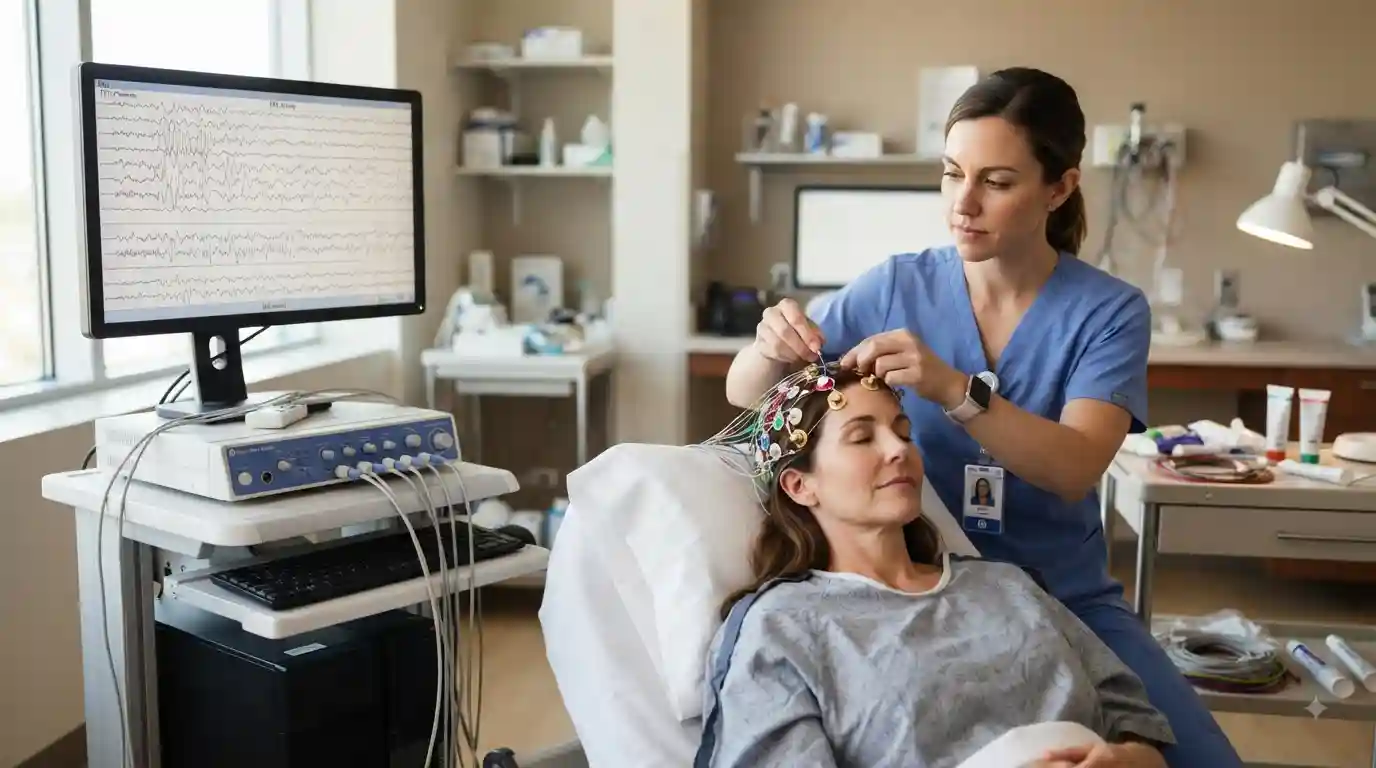
If you are considering a career in neurodiagnostics, understanding the electroneurodiagnostic technology salary can help you evaluate education options, certification requirements, specialization paths, and long-term earning potential. Electroneurodiagnostic technologists work with specialized testing equipment to help healthcare teams evaluate neurological function and identify abnormalities.
This guide explains salary benchmarks, factors that influence pay, career advancement opportunities, education requirements, certifications, and practical ways to improve your earning potential in the United States.
What Is Electroneurodiagnostic Technology?
Electroneurodiagnostic technology is a specialized healthcare field focused on recording and monitoring electrical or physiological activity associated with the nervous system. Technologists operate diagnostic equipment, prepare patients, collect high-quality recordings, recognize technical problems, and communicate relevant findings to physicians and other members of the clinical team.
Depending on training and credentials, professionals may work with EEG, epilepsy monitoring, evoked potentials, nerve conduction studies, polysomnography-related services, or intraoperative neuromonitoring.
The work requires more than simply operating equipment. Technologists must understand patient safety, electrode placement, recording quality, artifacts, technical troubleshooting, and procedure-specific protocols.
For professionals researching healthcare career options, related opportunities can also be explored through healthcare jobs and career opportunities.
What Is the Average Electroneurodiagnostic Technology Salary?
Salary figures for neurodiagnostic professionals depend heavily on the specific job title and credential. ASET’s published salary and benefits research reported an average annual salary of $75,515 among its survey respondents, with a median of $68,524. Salaried respondents reported an average of $76,166 annually, while respondents paid hourly reported an average rate of $35.49 per hour.
These figures should be treated as a professional-industry benchmark rather than a current universal salary for every U.S. technologist. Compensation changes over time and can vary by region, employer, modality, credentials, experience, and job responsibilities.
For comparison, ASET’s career resources show that current neurodiagnostic job postings can include substantially different compensation ranges depending on specialization and experience. Some advanced roles, particularly positions involving IONM or multiple neurodiagnostic modalities, may offer significantly higher compensation than entry-level EEG roles.
When evaluating salary information, it is therefore better to compare the complete compensation package rather than focusing on one national average.
Electroneurodiagnostic Technology Salary by Career Level
Entry-Level Neurodiagnostic Technologist
Entry-level professionals may begin with EEG-focused responsibilities, patient preparation, electrode application, routine recordings, equipment setup, documentation, and basic troubleshooting.
Entry-level compensation is generally influenced by education, clinical training, location, and whether the employer requires or prefers professional credentials.
Completing a formal training program can make candidates more competitive. ASET recommends formal Neurodiagnostic Technology education as a preferred pathway and recognizes multiple entry points into the profession.
Professionals exploring different educational routes may also find broader career-planning information in resources covering an associate degree pathway and career development through associate-level education.
Experienced Neurodiagnostic Technologist
With experience, technologists may take on more complex studies, work independently, support long-term monitoring, participate in epilepsy monitoring units, or develop expertise in additional modalities.
Experience can also strengthen a professional’s negotiating position when applying for positions with larger healthcare systems, specialized laboratories, or employers that need experienced technologists.
Senior and Specialized Technologists
Advanced professionals may move into senior technologist, lead technologist, specialist, or supervisory roles. Additional responsibilities can include mentoring staff, managing complex procedures, troubleshooting advanced equipment, assisting with quality assurance, and coordinating clinical operations.
Specialization is particularly important when evaluating long-term earning potential. A technologist with multiple credentials and experience across several modalities may have access to a broader range of opportunities than someone limited to one procedure type.
How Certification Can Affect Salary
Professional credentials can play an important role in career progression. Employers may prefer candidates who hold recognized neurodiagnostic credentials or require new hires to obtain them within a defined period.
Common credentials and specialty areas include Registered EEG Technologist (R. EEG T.), Certified Neurophysiologic Intraoperative Monitoring (CNIM), Registered Evoked Potential Technologist (R. EP T.), and Certified Long-Term Monitoring (CLTM), among others.
ASET’s salary research found that a large majority of respondents held at least one neurodiagnostic credential. The organization also reported that many employers provide incentives for obtaining professional credentials, including pay increases, examination reimbursement, study materials, and study time.
Certification should therefore be viewed as more than a resume enhancement. In some workplaces, it can directly affect eligibility for advanced positions and compensation opportunities.
Professionals interested in other certification-oriented career paths can also review information about professional certification and career advancement to understand how specialized credentials can support career development.
Education Requirements for Electroneurodiagnostic Careers
Education requirements vary between employers and specialties. ASET strongly recommends Neurodiagnostic Technology education through an appropriate accredited program. The organization also recognizes an associate degree or higher combined with specialty credentialing as part of its recommended professional preparation.
Some employers provide on-the-job training, especially for entry-level EEG positions. However, formal education can provide a stronger foundation in anatomy, physiology, neurodiagnostic procedures, patient care, equipment operation, and clinical safety.
ASET’s salary research found that respondents entered the field through multiple pathways, including formal Neurodiagnostic programs and on-the-job training. The report also noted that employers may provide structured training for newly hired technologists.
Those comparing healthcare education with other professional training models may find the site’s healthcare education resource useful for broader career-planning context.
Specializations That Can Increase Career Opportunities
One of the strongest ways to build long-term career value is to develop expertise in more than one neurodiagnostic area.
Electroencephalography
EEG is one of the best-known neurodiagnostic specialties. Technologists record brain electrical activity and may work in hospitals, outpatient centers, epilepsy programs, and specialized laboratories.
Long-Term and Epilepsy Monitoring
Long-term monitoring can involve extended observation and recording, often in specialized epilepsy or hospital settings. Professionals working in these environments may develop advanced technical and patient-monitoring skills.
Evoked Potentials
Evoked potential testing evaluates electrical responses associated with sensory stimulation. Experience with additional modalities can expand a technologist’s professional skill set.
Intraoperative Neuromonitoring
IONM can be one of the more advanced areas of neurodiagnostic practice. Technologists may monitor neurological function during surgical procedures and work closely with surgeons, anesthesiology teams, neurologists, and other specialists.
Because IONM involves specialized procedures and additional credentials may be required, professionals with the appropriate education, experience, and certification can qualify for higher-level positions.
This illustrates an important career principle: specialization can create access to different compensation levels rather than simply increasing pay automatically.
Location Matters When Comparing Salary
Geographic location can have a major effect on compensation. Large metropolitan healthcare markets, regions with shortages of qualified technologists, and facilities with advanced neurological programs may offer different salary structures from smaller markets.
However, a higher salary does not necessarily mean better financial value. Housing, transportation, taxes, insurance costs, and other living expenses should be considered when comparing job offers.
For example, a position offering a higher nominal salary may provide less disposable income if the local cost of living is substantially higher.
Location-based career decisions can also be compared with broader salary topics, such as this site’s guide to salary differences across specialized careers.
Healthcare Employer Benefits Can Change the Real Value of a Job
Salary is only one part of compensation. Healthcare employers may offer medical insurance, dental and vision coverage, paid time off, retirement contributions, tuition assistance, continuing education, professional membership support, certification reimbursement, flexible schedules, and shift differentials.
ASET’s salary research found that professional and healthcare benefits were common among survey respondents. Retirement plans and paid leave were also widely reported in the survey.
For this reason, two positions with similar annual salaries may have very different overall values.
When reviewing an offer, consider:
- Base salary or hourly rate
- Overtime opportunities
- Shift and weekend differentials
- On-call compensation
- Health insurance
- Retirement contributions
- Paid time off
- Certification reimbursement
- Continuing education support
- Tuition assistance
- Relocation benefits
- Sign-on bonuses
Retirement planning is another important part of long-term compensation. For broader retirement-related context, see the site’s guide to a retirement and pension strategy.
Skills That Can Improve Earning Potential
Technical credentials are important, but employers also value practical skills that help technologists work effectively in clinical environments.
- Patient communication: Patients may be anxious or unfamiliar with diagnostic procedures, so clear communication is essential.
- Technical troubleshooting: Identifying artifacts and equipment problems can protect recording quality.
- Attention to detail: Accurate electrode placement, documentation, and procedure execution matter.
- Critical thinking: Technologists must recognize technical and clinical situations that require appropriate escalation.
- Adaptability: Different modalities and patient populations require flexible technical approaches.
- Teamwork: Neurodiagnostic professionals regularly interact with physicians, nurses, surgeons, and other healthcare staff.
- Continuing education: Keeping current with technology and professional standards can improve long-term employability.
Career growth is also easier when professionals understand how education connects to workplace requirements. Resources such as adult education and career advancement can provide useful context when planning additional training.
Career Advancement Beyond the Technologist Role
Electroneurodiagnostic technology does not have to be a static career. Experienced professionals can move toward leadership, education, quality assurance, clinical coordination, management, or specialized technical roles.
A technologist with strong clinical experience may eventually become a lead technologist or supervisor. Others may move into laboratory management or educational roles.
Leadership positions can require a combination of clinical knowledge, communication skills, administrative ability, staffing experience, and an understanding of healthcare operations.
Professionals who are interested in broader business responsibilities may also explore career resources such as professional roles involving financial and operational coordination.
How to Evaluate an Electroneurodiagnostic Job Offer
When comparing positions, avoid choosing solely on the advertised salary. Build a complete compensation comparison.
Start by comparing the base salary or hourly rate. Then examine differentials, overtime, call requirements, bonuses, benefits, certification support, retirement contributions, and paid leave.
Next, evaluate the actual role. Ask whether the position provides exposure to new modalities, complex cases, experienced mentors, continuing education, or a clear advancement path.
A slightly lower starting salary may be worthwhile if the position provides structured training and a realistic route toward advanced certification. Conversely, a higher-paying job may have limited advancement opportunities or demanding on-call expectations.
Questions to Ask Before Accepting a Position
Career candidates can use the following questions during interviews or offer negotiations:
- What is the expected salary range for this position?
- Is compensation hourly, salaried, or a combination?
- Are shift, weekend, or on-call differentials available?
- Does the employer reimburse credentialing or examination costs?
- What certifications are required?
- What certifications are preferred for advancement?
- How much training is provided to new employees?
- Which neurodiagnostic modalities are performed?
- Are there opportunities to cross-train?
- What is the typical career progression within the department?
- Are continuing education expenses covered?
- What retirement and health benefits are included?
These questions can help candidates compare opportunities based on long-term career value rather than starting compensation alone.
Is Electroneurodiagnostic Technology a Good Career?
Electroneurodiagnostic technology can be a strong career choice for people who enjoy healthcare, technology, patient interaction, and specialized diagnostic work. The field offers several pathways for professional development, particularly for individuals willing to pursue additional credentials and modalities.
The profession also provides opportunities to work in different clinical environments, from routine EEG services to specialized epilepsy programs and operating-room neuromonitoring.
However, candidates should understand that salary depends on multiple variables. Education, certification, experience, specialty, employer, geographic location, schedule, and responsibilities can all affect compensation.
Final Thoughts on Electroneurodiagnostic Technology Salary
The electroneurodiagnostic technology salary landscape offers several opportunities for professionals who deliberately build their skills and credentials. Industry salary research provides useful benchmarks, but individual compensation can vary significantly based on experience, specialization, location, and employer.
For someone entering the field, a sensible strategy is to establish a strong technical foundation, pursue appropriate education, work toward recognized credentials, and gradually develop expertise in advanced modalities.
Career growth should also be evaluated beyond salary. Professional development, benefits, work environment, training, advancement opportunities, and specialization can have a major impact on long-term career satisfaction and financial value.
By treating education and credentialing as long-term investments, aspiring and experienced neurodiagnostic professionals can make better-informed decisions about where to begin, when to specialize, and how to move toward higher-level opportunities.