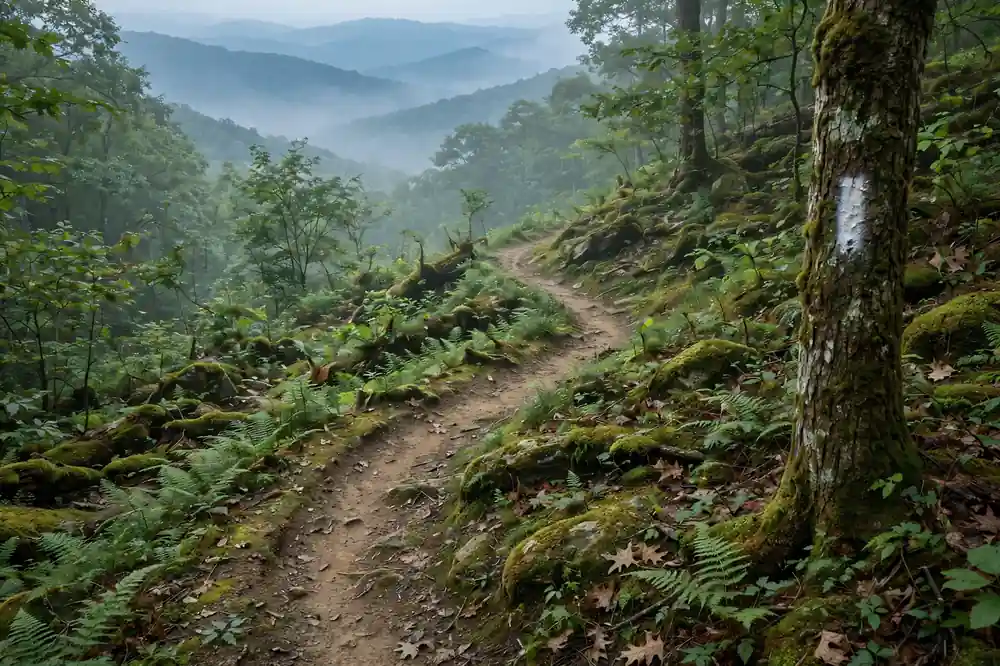
The Appalachian Trail is 2,197.9 miles long. Let that number sit for a moment: nearly 2,200 miles of white-blazed footpath running from Springer Mountain in Georgia to the summit of Katahdin in Maine, through 14 states, eight national forests, and six national park units. Every year thousands of hikers set out to walk the whole thing in one trip; roughly one in four makes it. The rest discover something the finishers already know — that the Trail is not really about the miles. It is about the slow rewiring that happens when your whole world fits in a backpack and the only appointment on your calendar is the next white blaze. This Appalachian Trail hiking guide covers everything: how to thru-hike it, how to section-hike it over years, and how to sample its greatest day hikes without quitting your job.
The official length comes from the Appalachian Trail Conservancy, which remeasures the Trail every year — in 2026 it stands at 2,197.9 miles, or about 3,537 kilometers. The path was first thru-hiked in 1948 by Earl Shaffer, who walked it to “walk the war out of his system.” Today the Trail is maintained almost entirely by volunteers, and anyone who completes it — in one trip or over a lifetime of section hikes — earns the title of 2,000-miler. Whether you dream of six months in the woods or one perfect weekend, the best hiking trails in the USA start here.
Appalachian Trail Hiking: The Three Ways to Walk It
Thru-Hiking: The Whole Trail in One Trip
A thru-hike means completing the entire Trail within 12 months — almost always in a single continuous journey of five to seven months. The average thru-hike takes about 165 days. Most hikers start at 12 to 15 miles a day and build to 18 or 20 as their trail legs arrive. About 90 percent of thru-hikers go northbound (NOBO), starting at Springer Mountain between late February and early April, hiking with the spring as it blooms northward, and racing Baxter State Park’s mid-October Katahdin closure. The remaining 10 percent go southbound (SOBO), starting at Katahdin in June once the park opens, enjoying smaller crowds and fall foliage at the finish. A third option, the flip-flop, starts mid-trail — typically Harpers Ferry, West Virginia — and hikes one direction, then the other. Budget roughly $5,000 to $8,000 or more for the full journey, not counting gear. Before committing, read our budget backpacking tips — the Trail rewards the frugal and punishes the unprepared in equal measure.
Section Hiking: The Trail Over Years
Section hiking means completing the Trail in pieces — a week here, a long weekend there, over years or decades. It is how most 2,000-milers actually finish, and it has real advantages: you hike every section in its best season, you keep your job, and your knees get rest years. The classic strategy is to knock out the hardest sections (New Hampshire’s White Mountains, Maine’s Hundred-Mile Wilderness) when you are youngest and fittest. Keep a log — the ATC recognizes section hikers with the same 2,000-miler status as thru-hikers. Many section hikers plan their trips around our USA road trip routes, pairing a week on the Trail with a scenic drive.
Day Hiking: The Greatest Hits
You do not need months to experience the AT’s best miles. Iconic day hikes include McAfee Knob in Virginia (the most photographed spot on the entire Trail), the wild ponies of Grayson Highlands, the 360-degree grassy summit of Max Patch in North Carolina, and the brutal, beautiful Presidential Range in New Hampshire’s White Mountains. The Trail crosses the Blue Ridge Parkway repeatedly, making fall day hikes in Virginia and North Carolina almost unfairly scenic. If you are new to hiking, start with our beginner camping guide before your first overnight.
The Iconic Sections Every Appalachian Trail Hiker Should Know
Georgia and North Carolina: The Crucible
The southern terminus sits atop Springer Mountain (3,782 feet), and the first 75 miles through Georgia are famously humbling — the Trail’s hardest climbing per mile is in the South, not the North. Blood Mountain, the highest peak on the Georgia AT, delivers the first real summit view. Crossing into North Carolina, the Trail climbs through the Nantahalas to Max Patch, a grassy bald with views that stretch into three states, and the Smokies section — which requires a backcountry permit — crosses the Trail’s highest point at Kuwohi (6,643 feet). The southern Appalachians feel ancient and enclosed, tunnels of rhododendron giving way to sudden, staggering views.
Virginia: The Long Green Tunnel (With Payoffs)
Virginia holds more AT miles than any other state — over 540 — and its reputation as a “green tunnel” is half fair. But the payoffs are enormous: McAfee Knob’s diving-board overlook, the otherworldly rock formations of Dragon’s Tooth, the wild ponies and open highlands of Grayson Highlands State Park, and Shenandoah National Park’s 100-plus miles of gentle ridge walking (permit required for backcountry camping) with waysides serving blackberry milkshakes every 20 miles. Thru-hikers hit Virginia in May and June, when the rhododendron blooms turn the tunnel into a garden.
The Mid-Atlantic: Rocks, History, and the Halfway Point
Pennsylvania’s nickname — Rocksylvania — is earned: miles of ankle-twisting rock gardens that destroy boots and egos. But the state also holds the Trail’s official halfway point near Pine Grove Furnace, home of the half-gallon challenge (eat a half gallon of ice cream to mark the milestone). New Jersey and New York surprise hikers with genuine wilderness and the Trail’s lowest elevation at the Hudson River. Harpers Ferry, West Virginia, is the spiritual midpoint and home of the ATC headquarters, where every thru-hiker poses for the registry photo.
New England: The Grand Finale
Vermont’s Long Trail shares 100 miles with the AT. New Hampshire’s White Mountains are the hardest miles on the entire Trail — above-treeline traverses, boulder scrambles, and weather that can turn lethal in any month. Then Maine: the wildest state on the Trail, ending with the Hundred-Mile Wilderness, the longest roadless stretch, and the final climb up Katahdin (5,269 feet), where children under six are not permitted to summit and the mountain simply ends. Thru-hikers touch the sign, cry a little, and wonder what to do with the rest of their lives. The northern forests rival anything in our Olympic hikes guide for primeval atmosphere — and the Acadia trails make a perfect cool-down trip after Katahdin.
Permits, Registration, and 2026 Logistics
The AT is remarkably permit-light: only three areas require permits — Great Smoky Mountains National Park, Shenandoah National Park, and Baxter State Park. Everything else is open. The ATC strongly encourages voluntary registration at ATCamp.org, which helps spread out start dates and reduce crowding at Springer Mountain. NOBO hikers should start between March 1 and mid-April; starting earlier risks deep snow in the Smokies, starting later risks racing winter to Katahdin. SOBOs should start at Katahdin in June. There is no fee to hike the Trail itself, but budget for town stops: laundry, resupply, the occasional motel bed, and the legendary trail-town breakfast. The total elevation gain and loss over a thru-hike is roughly 500,000 feet — equivalent to climbing Everest 16 times from sea level.
Gear, Safety, and Trail Culture
The modern thru-hiker’s base weight (everything except food and water) typically runs 10 to 20 pounds. The big three — pack, shelter, sleep system — matter most, followed by a reliable water filter (norovirus and giardia are the Trail’s least romantic traditions). Ticks are the real danger animal: treat clothes with permethrin, check nightly, and know Lyme disease symptoms. Black bears are common but rarely aggressive; use the provided bear boxes and cables, and hang food where required. Trail culture has its own language: a “zero” is a rest day, a “nero” is a near-zero, “trail magic” is unexpected kindness (coolers of soda at road crossings, rides into town), and your “trail name” — bestowed by fellow hikers, never chosen — will follow you forever. The community is the Trail’s greatest safety net; solo hikers are rarely truly alone in thru-hiker season. For perspective on how the AT compares to the West’s great trails, our Zion, Glacier, and Rocky Mountain guides cover the other end of the American hiking spectrum.
Frequently Asked Questions About Appalachian Trail Hiking
How long does it take to thru-hike the Appalachian Trail?
Five to seven months for most hikers, averaging about 165 days. Exceptionally fit hikers finish in under 100 days, but that pace misses the point for most people.
How much does an AT thru-hike cost?
Roughly $5,000 to $8,000 or more for on-trail expenses, plus $1,000 to $2,000 for gear if you are starting from scratch. Town stops are the budget killer.
Can beginners thru-hike the Appalachian Trail?
Yes — most thru-hikers are beginners. The Trail is a superb teacher because the southern states build your fitness gradually. Start with shakedown hikes, keep your pack light, and listen to your body.
What is the best month to start?
For northbound hikers, late March to early April hits the sweet spot: spring wildflowers, manageable Smokies weather, and enough time to reach Katahdin before mid-October.
Conclusion
Appalachian Trail hiking is not really a hike; it is a temporary way of life. Whether you walk all 2,197.9 miles, collect sections over a decade, or simply stand on McAfee Knob at sunrise, the Trail gives you the same gift: proof that you can carry everything you need and want nothing you cannot carry. Start planning now — the white blazes will be waiting when you are ready.