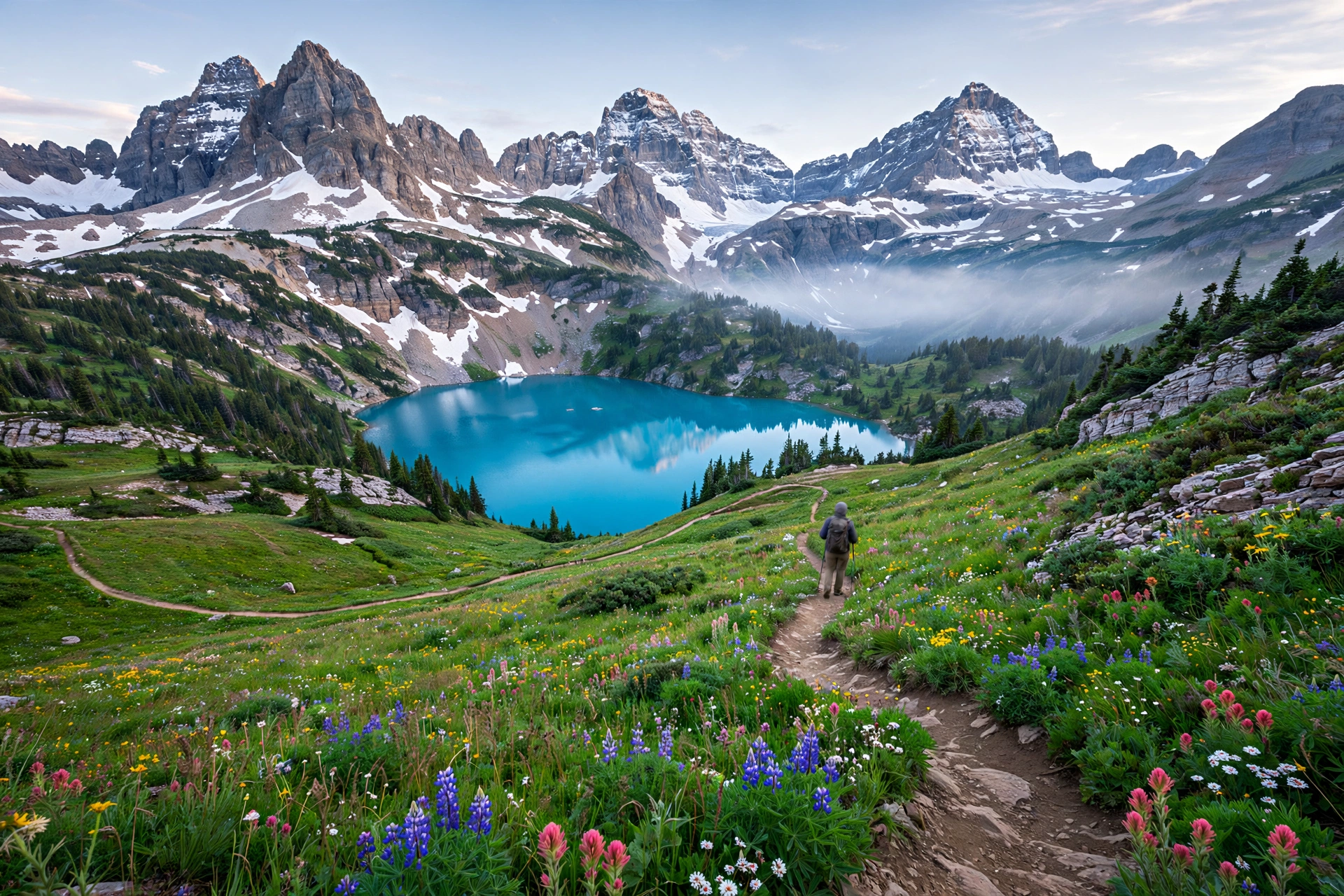
Ask a hiker to name the most jaw-dropping place in the Lower 48 and Glacier National Park comes up again and again. Jagged, glaciated peaks. Turquoise lakes. Wildflower meadows along the Continental Divide — and some of America’s finest trails. This guide rounds up the best hikes in Glacier National Park, from easy to challenging, plus the permits, timing, and bear-safety basics first-timers need to know.
Before You Hit the Trail: What First-Timers Must Know
Going-to-the-Sun Road Vehicle Reservations
The park’s crown jewel, the 50-mile Going-to-the-Sun Road, has required a timed vehicle reservation during peak season in recent years (typically late June through early September). You need a separate reservation from your park entrance pass, and tickets sell out fast — book online when the next release window opens. Many of the best trailheads sit along this road, so securing your vehicle reservation is step one of the trip.
Season Timing Is Everything
Glacier’s high trails are snow-covered well into summer. Late June to mid-September is the reliable hiking window; the Logan Pass area at the top of Going-to-the-Sun Road often doesn’t fully open until late June or early July, and snow can linger on high passes into August. July and August bring the best weather but also the biggest crowds and scarce parking. Early September is the sweet spot: fewer people, fall color starting, and most trails still passable.
Grizzly Country: Bear Safety
Glacier is prime grizzly habitat, and bears are active on many trails. Every hiker should carry bear spray (accessible on your hip, not buried in your pack), make noise on blind corners, hike in groups when possible, and never approach or feed wildlife. Park rangers occasionally close trails for bear activity — check the current trail status board before you head out each morning.
The Best Easy Hikes in Glacier National Park
Trail of the Cedars and Avalanche Lake (4.5 miles round trip)
This is the perfect first hike in Glacier. The trail starts on a flat, wheelchair-accessible boardwalk through an ancient grove of western redcedar and hemlock, then climbs steadily along Avalanche Creek — a cascade-filled gorge of red rock — to Avalanche Lake, where waterfalls pour off the cliffs directly into a lake ringed by peaks. Under 5 miles, family-friendly, and endlessly photogenic. Go early to beat the crowds.
Hidden Lake Overlook (2.7 miles round trip)
Starting at Logan Pass, this boardwalk trail climbs a wildflower-carpeted slope to an overlook of Hidden Lake, framed by the pyramidal mass of Bearhat Mountain. Mountain goats graze here so regularly that the trail occasionally closes to give them space. It’s short and the payoff is enormous — though parking at Logan Pass fills by 8 a.m., so arrive early or take the park shuttle.
The Best Moderate Hikes in Glacier National Park
Iceberg Lake (9.7 miles round trip)
Begin at Swiftcurrent Motor Inn in the Many Glacier area and climb through pine forest and open meadows to a glacial cirque lake where icebergs float well into summer. The wildflower displays in July are legendary, and grizzly sightings are common enough that bear spray is non-negotiable. Strong hikers can finish it in a half day; everyone else should start by 9 a.m.
Ptarmigan Tunnel (10.7 miles round trip)
For something genuinely unique: a trail that ends at a 1930s railroad-style tunnel blasted through a mountain saddle. The walk-through-the-mountain finale is pure drama, and the Ptarmigan Wall views from the far side rival anything in the Alps. The steady, moderate grade makes this an excellent full-day hike for fit first-timers who want something beyond the obvious.
The Best Challenging Hikes in Glacier National Park
Highline Trail to Granite Park Chalet (11.8 miles one way)
The Highline Trail is arguably the single most famous trail in the park, and for good reason: it contours along the Garden Wall high above Going-to-the-Sun Road, with mile after mile of open views. The first quarter mile crosses a narrow ledge with a hand cable — safe but vertigo-inducing — and then the walking is gloriously gentle. End at the historic Granite Park Chalet, overnight there, or continue down the Loop Trail to a shuttle pickup.
Grinnell Glacier (10.6 miles round trip)
If you want to see a real, living glacier while you still can, this is the hike. The trail from Many Glacier climbs past three turquoise lakes — Swiftcurrent, Josephine, and Grinnell — before a steep final ascent to the Grinnell Glacier overlook. Rangers estimate Glacier’s named glaciers have shrunk dramatically in the last century; standing at the terminus of one of the largest survivors is humbling. Note that the final section can hold snow into August, so check conditions.
Siyeh Pass (10.3 miles round trip)
A tougher, less-crowded alternative to the Highline: a lung-busting climb past Sexton Glacier and Preston Park meadows to a saddle with a 360-degree panorama of the St. Mary valley. Fit hikers looking for solitude should put this at the top of their list.
Planning Tips for First-Time Glacier Visitors
- Stay inside the park if you can. Lodging at Many Glacier, Lake McDonald, or Rising Sun puts you at the trailheads; the Granite Park Chalet and Sperry Chalet are backcountry experiences worth booking a year ahead.
- Use the shuttles. The free Going-to-the-Sun Road shuttle and paid hiker shuttles solve the parking problem and enable point-to-point hikes like the Highline.
- Pack for four seasons. A sunny 75°F morning at Logan Pass can turn into 40°F sleet by afternoon — bring a rain shell and a warm layer every single day.
- Eat a real breakfast and carry 2–3 liters of water. Glacier’s day hikes are longer than they look on the map, and altitude (Logan Pass sits at 6,646 feet) sneaks up on flatlanders.
Keep Exploring America’s Great Trails
One park visit usually turns first-timers into lifelong trail chasers. When you’re ready for more, work through the best hiking trails in the USA for every skill level to plan your next big hike, or cross the border to pair Glacier with the places to visit near Jasper National Park for an epic northern Rockies combo trip. New to spending nights in the backcountry? Our camping-for-beginners guide covers everything from tents to camp kitchens. And if you’re road-tripping to Montana, the ultimate USA road trip planner has route ideas and logistics, while our Capitol Reef lodging guide shows how to pick a base for any national park trip. Still craving bigger thrills? Check out the most thrilling adventure activities in the USA for what’s next.
Final First-Timer Checklist
- Going-to-the-Sun Road vehicle reservation + park entrance pass
- Bear spray, carried accessibly, plus a rain shell and warm layer
- One easy hike (Avalanche Lake), one moderate (Iceberg Lake), one big day (Highline or Grinnell Glacier)
- Early starts — parking at Logan Pass fills by 8 a.m.
Glacier is the “Crown of the Continent” for a reason: no American park packs this many world-class trails into such a compact area. Respect the weather and the wildlife, and your first visit will almost certainly not be your last.