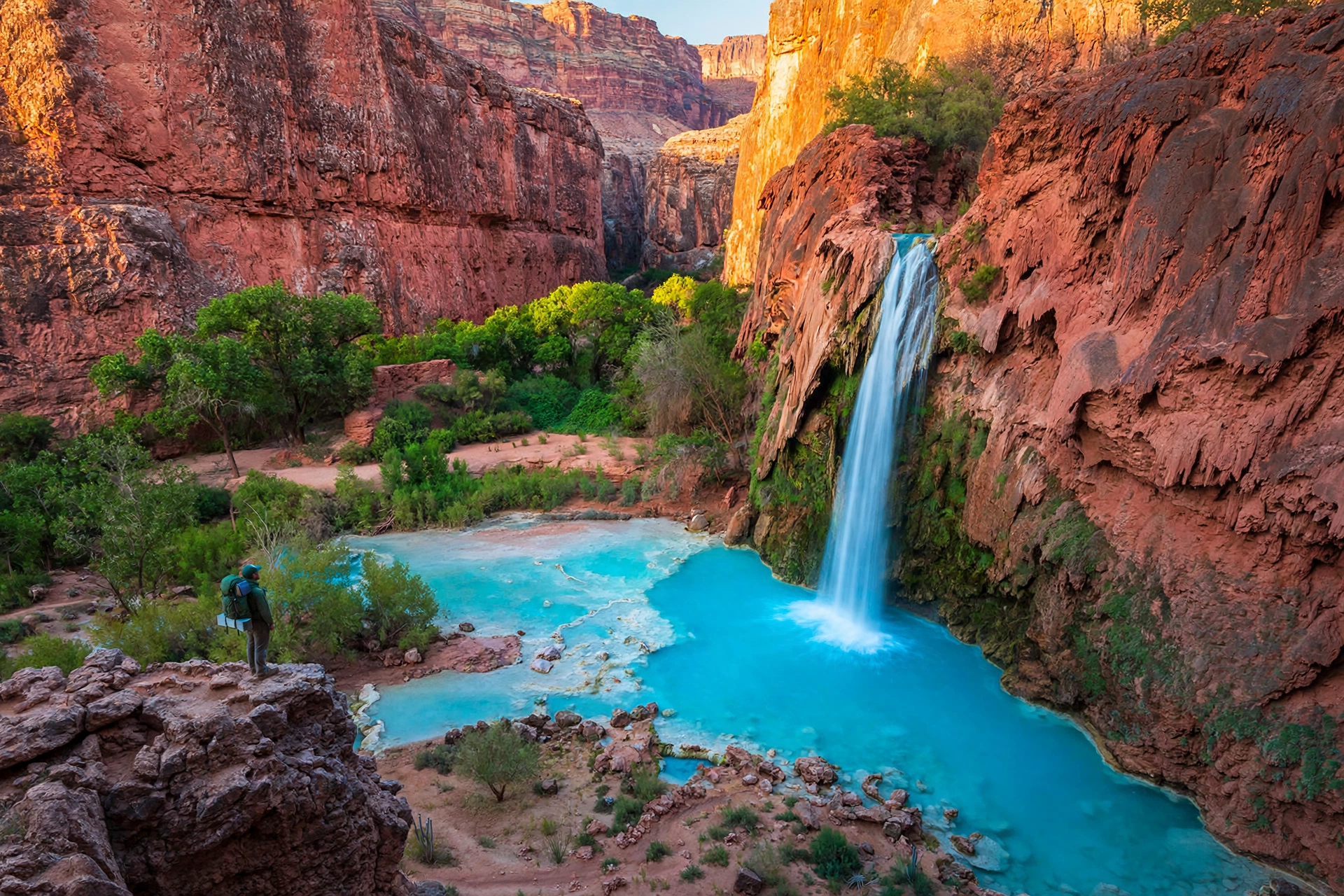
There are places you photograph, and then there are places that photograph themselves into your memory. The Havasu Falls hike belongs firmly in the second category. Tucked inside Havasu Canyon, deep in the Grand Canyon system, a series of waterfalls pour over travertine ledges into pools of impossible, almost tropical blue-green water — all of it framed by burnt-red desert cliffs. It looks like the Caribbean dropped into the Arizona desert — and reaching it takes a 10-mile trek. This complete guide covers permits, the trail mile by mile, the best season, packing, and safety.
What Is the Havasu Falls Hike?
The Havasu Falls hike begins at Hualapai Hilltop, the trailhead at the end of a long dirt road off Route 66 in northwest Arizona. From there, you descend 8 miles to Supai Village — the only US village still served by mule-train mail — then continue 2 miles past the falls to the Havasupai Campground. The round trip is roughly 20 miles, with 2,000 feet of elevation lost on the way in and regained on the way out.
The one critical rule: day hiking is not allowed. You need an overnight reservation for the Havasupai Campground (or the Havasupai Lodge in Supai Village), sold for 3-night / 4-day stays. This is a true multi-day backpacking trip — part of what keeps the canyon uncrowded.
How to Get a Havasu Falls Permit in 2026
Permits are controlled by the Havasupai Tribe and sold through the tribe’s official reservation site. They are among the most competitive wilderness permits in America — the entire season sells out within hours when reservations open on February 1 each year. Set a reminder, create your account in advance, and be logged in and ready at the opening minute.
Expect to pay roughly $400 per person for the 3-night stay (confirm current pricing on the official site before you plan). Every group member must be on the reservation, and permits are non-transferable. An official transfer list lets permit holders legally resell reservations — the only legitimate way to grab a spot outside the February rush.
Reservation Tips That Actually Work
- Flexibility beats everything. Shoulder-season dates (March, April, late October, November) last slightly longer than peak spring dates.
- Go midweek. Tuesday-through-Thursday starts sell out last.
- Watch the transfer list. Cancellations appear regularly, sometimes just weeks before the date — check it every morning if you’re determined to go this year.
- Book with a small group. Fewer people means more available dates.
The Trail: Mile by Mile
Hualapai Hilltop to Supai Village (8 miles)
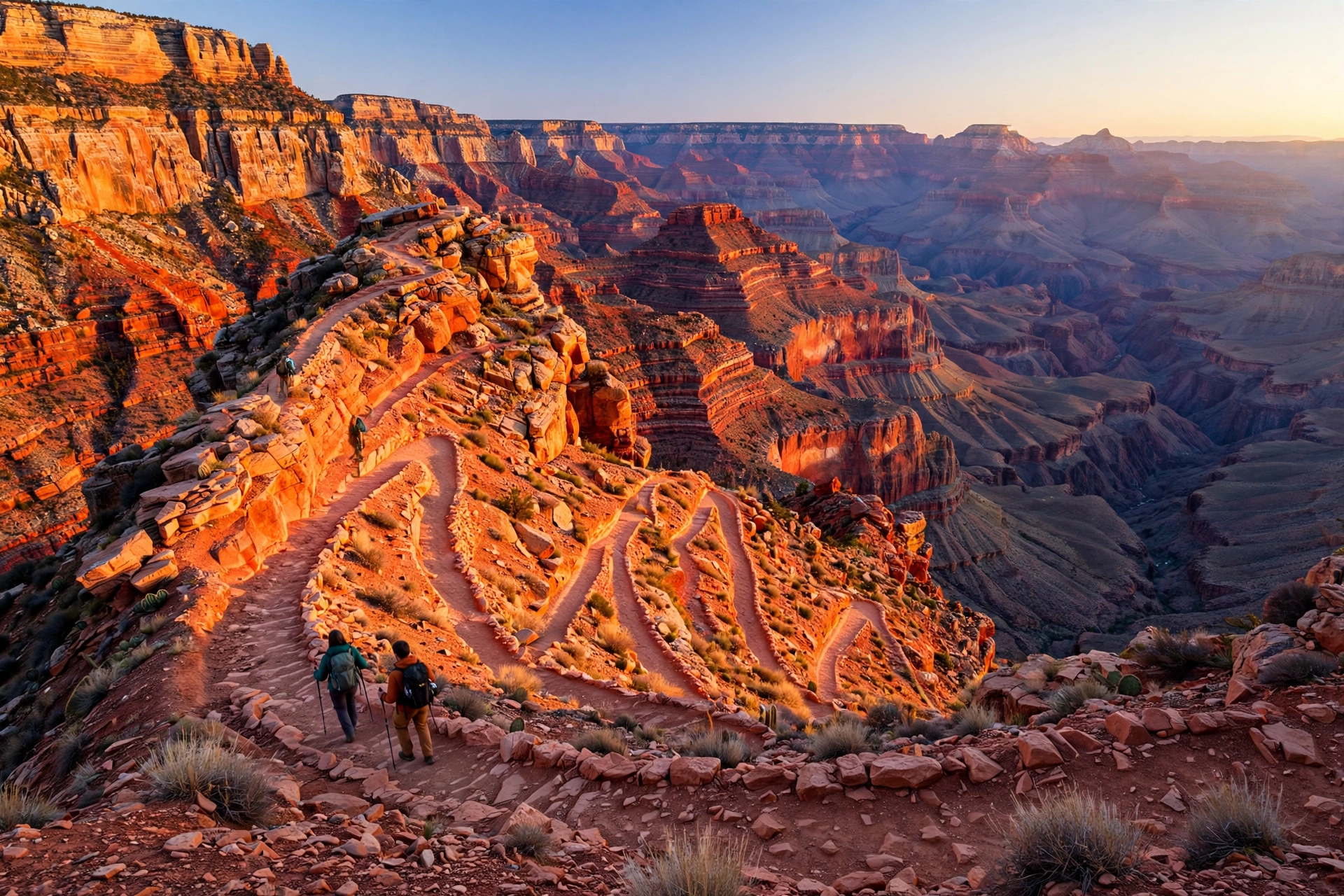
The first mile and a half is the steepest part of the trip — dusty switchbacks dropping off the canyon rim — before the trail levels out along a wide, exposed, shadeless wash. Save your legs: the real climbing happens on the way out. After about 8 miles you reach Supai Village, where you check in at the tourist office, refill water, and grab snacks at the small café and general store.
Supai Village to the Campground (2 miles)
This is where the trip turns magical. Half a mile past the village, the canyon narrows and you’ll hear Navajo Falls, then round a corner to see Havasu Falls itself — a 100-foot cascade pouring over a wide travertine lip into a milky turquoise pool. The campground begins just past the falls, stretching about a mile along Havasu Creek.
Beyond the Campground: Mooney and Beaver Falls
Don’t stop at the campground. Half a mile below it, Mooney Falls — taller and wilder at nearly 200 feet — is reached via a heart-thumping descent through rock tunnels and down a wet, chain-assisted cliff ladder. Another 3 miles of creek-wading brings you to Beaver Falls, a multi-tiered cascade of small blue pools many hikers call the prettiest spot in the canyon. Both make outstanding day hikes from camp.
Best Time to Do the Havasu Falls Hike
- March to May: The sweet spot. Wildflowers, full waterfalls, daytime highs in the 70s–80s. Swimmable by May.
- June to August: Brutally hot (100°F+) plus monsoon flash-flood risk; the canyon has closed after floods. Hike at night or early morning only.
- September to November: The second sweet spot. Warm days, cooler nights, far fewer crowds.
What to Pack
There is no water on the 8-mile approach trail, so carry at least 3–4 liters per person for the hike in. Supai Village has treated water, and the campground has a spring (treat or filter it anyway). Beyond the standard backpacking essentials for a first overnight trip, a few Havasu-specific items earn their weight:
- Water shoes with toe protection — you’ll cross Havasu Creek constantly between Mooney and Beaver Falls.
- A rat-proof bag or bear canister — squirrels in the canyon are legendary food thieves.
- Swimsuit and quick-dry towel — swimming in the pools is half the point of the trip.
- Trekking poles — the 2,000-foot climb out is far kinder with poles.
- Sun protection — wide-brim hat, sunscreen, and sunglasses; the approach wash is fully exposed.
Safety and Leave No Trace
Heat is the biggest danger on this hike. Start before sunrise in warm months — the climb out in afternoon heat has ended trips and worse. Flash floods can surge through the canyon during monsoon season; never camp near the creek edge in summer, and obey any tribal instructions to move to high ground.
Pack out everything you pack in, including food scraps and toilet paper. The Havasupai Tribe has asked visitors repeatedly to respect this place — it is their home, not just a backdrop. Stay on trails, don’t carve your name into travertine, and give the pack mules the right of way.
How Havasu Falls Compares to Other USA Adventures
If the logistics of Havasupai feel intimidating, you’re not alone — it helps to build up to it. Work your way up through the best hiking trails in the USA for every skill level to find overnight trips that match your fitness, or test your backcountry legs on some of the most thrilling adventure activities in the USA before committing to 20 miles in the desert. And if you’re already planning an Arizona trip, you can pair the falls with a wider itinerary using the ultimate USA road trip planner — the Hualapai Hilltop detour fits naturally into a Southwest loop. Visiting in the cooler months? Our guide to the best places to visit in Arizona in winter has ideas for the rest of your trip, and if the permit price stings, these backpacking-on-a-budget tips will help you cut costs elsewhere.
Final Checklist Before You Go
- Permit secured on the official Havasupai reservation site (February 1 release)
- 3–4 liters of water per person for the approach hike
- Camp gear rated for desert nights, plus a swimsuit
- Water shoes and traction-good hiking shoes
- Printed reservation confirmation (cell service is nonexistent in the canyon)
The Havasu Falls hike is not easy — it’s hot, it’s long, and the permit system will test your patience. But nothing prepares you for rounding that corner and seeing turquoise water spilling over red rock where the desert says it shouldn’t be. Get the permit, train for the miles, and go.