Austin runs on three things: live music, smoked meat, and cold spring water. The best things to do in Austin combine all three, usually in the same day — a morning swim, a BBQ lunch that ruins you for all other BBQ, and music drifting out of a dozen doorways by night. This guide helps you plan exactly that kind of trip.
Austin also works in almost any season. Winters are mild, springs are glorious, and even the fierce summer heat has a built-in answer: the city’s spring-fed swimming holes stay cold all year. Here is how to make the most of it.
The Best Things to Do in Austin Downtown and on South Congress
Start at the Texas State Capitol. The pink granite building — taller than the US Capitol, as Texans will happily tell you — offers free guided tours, and the surrounding grounds are shaded by huge live oaks. It anchors the north end of downtown and gives you your bearings.
Then walk or ride down to South Congress Avenue, known to everyone as SoCo. This is Austin’s classic stroll: boot shops, vintage stores, murals, and coffee counters, all facing a postcard view of the Capitol at the end of the street. Stop for a photo at the famous “i love you so much” wall on South Congress — the line moves fast.
Two museums reward a downtown hour. The Blanton Museum of Art on the University of Texas campus holds a strong modern collection and Ellsworth Kelly’s glowing “Austin” building outside. The LBJ Presidential Library nearby covers a turbulent era of American history with unusual honesty.
Live Music, Austin Style
Austin calls itself the Live Music Capital of the World, and on any given night the claim is easy to believe. Sixth Street is the loud, famous version — blocks of bars with bands in every window, closed to cars at night on weekends. It is chaotic, fun, and best in small doses.
For the grown-up version, try the Continental Club on South Congress, a landmark venue where legends and locals share a small stage, or the listening rooms and dance halls scattered through East Austin. Rainey Street, a strip of bungalow bars with food trucks in every yard, sits happily in between the two moods.
Timing a trip around a festival changes everything. South by Southwest fills March, and the Austin City Limits Music Festival takes over Zilker Park across two October weekends. Both are worth it for music lovers, but book rooms far ahead and expect the whole city to run at festival pace.
BBQ and Food Trucks
Central Texas BBQ is a pilgrimage food: brisket, beef ribs, and jalapeño sausage, served by weight on butcher paper with pickles and white bread. Franklin Barbecue is the most famous name, and its morning line is part of the experience — arrive early, bring coffee, and treat the wait as a tailgate. Excellent alternatives around town serve shorter lines and equally smoky brisket.
Beyond BBQ, Austin is a food truck city to its core. Tacos are the other essential food group, from breakfast tacos in the morning to late-night al pastor. Our roundup of the best food cities in the USA explains where Austin ranks nationally — and why its food scene punches so far above its size.
Do not leave without trying queso in its natural habitat. Austin treats the molten cheese dip as a competitive sport, served with chips at Tex-Mex institutions across town and argued about with real passion. The same goes for the food truck parks scattered through the east side and South Lamar, where a single parking lot might hold Thai, Ethiopian, and doughnut trailers side by side. Ordering one small thing from three trucks is not indecision here — it is the correct strategy.
Swimming Holes and the Outdoors
Barton Springs Pool is the soul of Austin: three acres of spring-fed water inside Zilker Park, holding about 68 degrees all year. Locals swim here in January. Grassy hills surround the pool for lounging, and the early-morning lap hours are a beloved local ritual.
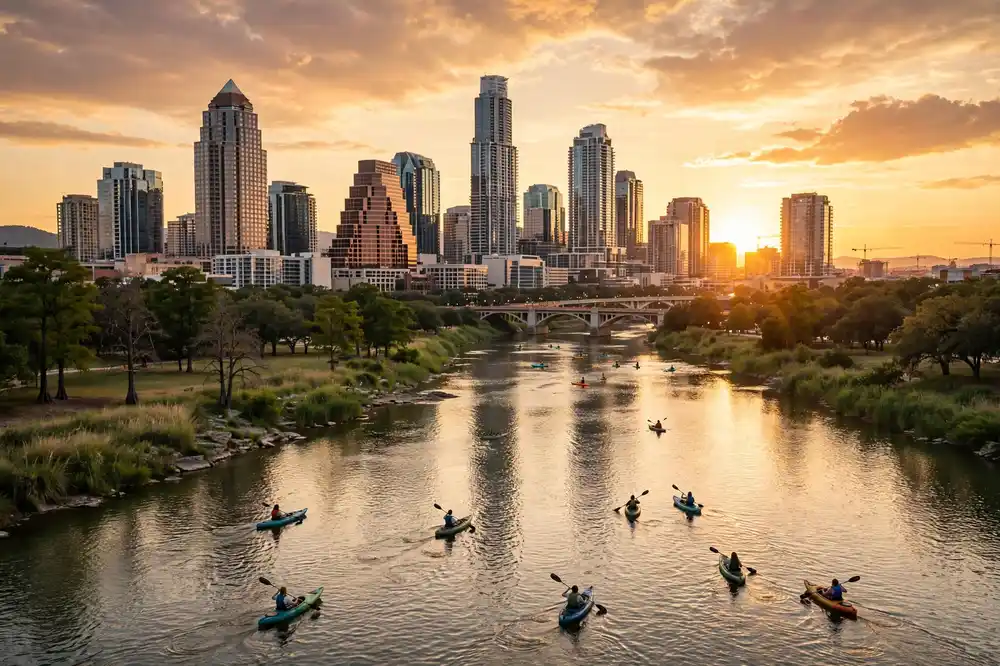
The Ann and Roy Butler Hike-and-Bike Trail circles Lady Bird Lake through the middle of downtown. Walk it, run it, or rent a kayak or paddleboard and watch the skyline from the water. At dusk from March through October, gather on the Congress Avenue Bridge to watch North America’s largest urban bat colony stream out for the night — 1.5 million bats putting on a free show.
More swimming waits outside the center. Hamilton Pool Preserve, a collapsed grotto west of the city, requires advance reservations and is worth every bit of planning. Lake Travis, covered in our guide to the best lake towns in the USA, adds boating and lakeside restaurants to the mix.
Stay inside Zilker Park a little longer and the day keeps giving. The Zilker Botanical Garden threads themed gardens — including a serene Japanese garden — across the hillside, and the Umlauf Sculpture Garden sits quietly nearby under the oaks. The Zilker Zephyr miniature train has looped the park for generations, and locals treat the whole park as the city’s shared backyard, because that is exactly what it is.
Easy Day Trips from Austin
The Hill Country begins at Austin’s western edge. Our Texas Hill Country road trip strings together Fredericksburg’s wineries and German bakeries, Enchanted Rock’s pink granite dome, and barbecue towns like Lockhart, the official BBQ capital of Texas. It is the single best use of a spare day.
San Antonio is only about 80 miles south — an easy day trip or overnight. Pair this guide with our San Antonio travel guide for the Alamo, the River Walk, and the Spanish missions. Dallas, a few hours north, completes the Texas triangle; our Dallas travel guide covers its arts district and Dealey Plaza history. For a quieter rural detour, the stops in our guide to places to visit near San Angelo, TX suit a longer Texas loop.
A Perfect Austin Day, Hour by Hour
If you have just one day, spend it like this. Start with breakfast tacos and coffee from a food truck, then tour the Capitol while the morning is cool. By late morning, be in the water at Barton Springs — the earlier you arrive, the more local the scene feels.
Lunch is BBQ, eaten slowly, followed by a deliberate rest: a shady patio, a museum hour at the Blanton, or a nap, because Austin rewards those who pace themselves in the heat. Late afternoon belongs to South Congress — shops, murals, and coffee — and then the Congress Avenue Bridge at dusk, when the bats pour out over the lake as the sky turns orange.
Finish with dinner from a food truck park and a band in a small room on South Congress or in East Austin. That single loop — swim, smoke, stroll, bats, music — captures the city better than any checklist of sights.
Practical Tips for Austin
Heat is the main planning factor. From June through September, build your days like locals do: outdoor activities early, long lunches and museums at midday, and music after dark. Carry water everywhere, and treat the springs as your daily reset button.
Getting around downtown is easy on foot, by scooter, or with the CapMetro bus and rail lines, but Austin spreads out fast. Most visitors rent a car for Hill Country and swimming hole days — the routes in our USA road trip planner show how Austin anchors a bigger Texas drive. Flying in instead? Fares jump around festivals, so use the strategies in our guide to cheap flights before booking.
Compare music cities while you plan. Austin’s closest rival is Tennessee’s capital, and our Nashville travel guide covers the honky tonk version of the same idea. Further east, the squares and ghost tours in our Savannah travel guide offer a slower Southern counterpoint to Austin’s energy.
Quick Questions, Answered
How many days do you need in Austin? Three days covers downtown, the music scene, BBQ, and the springs. Add a fourth for a Hill Country or San Antonio day trip.
What food should I try first? Brisket at a top BBQ joint and a breakfast taco the next morning. Between the two, you will understand Austin’s kitchen completely.
When is the best time to visit? March through May and October through November bring the kindest weather — and the biggest festivals. Summer works if you plan around the heat and swim daily.
Is Austin expensive? It can be, around festival weekends, but day to day it stays friendly: the signature experiences — swimming at Barton Springs, the bats, the Capitol grounds, window-shopping on South Congress — cost little or nothing, and food truck lunches beat most cities’ restaurant prices.
The Bottom Line
The best things to do in Austin are simple pleasures done exceptionally well: hear a great band in a small room, eat brisket that lives up to the legend, and cool off in spring water that never warms up. Plan your days around those three, and Austin will do the rest.