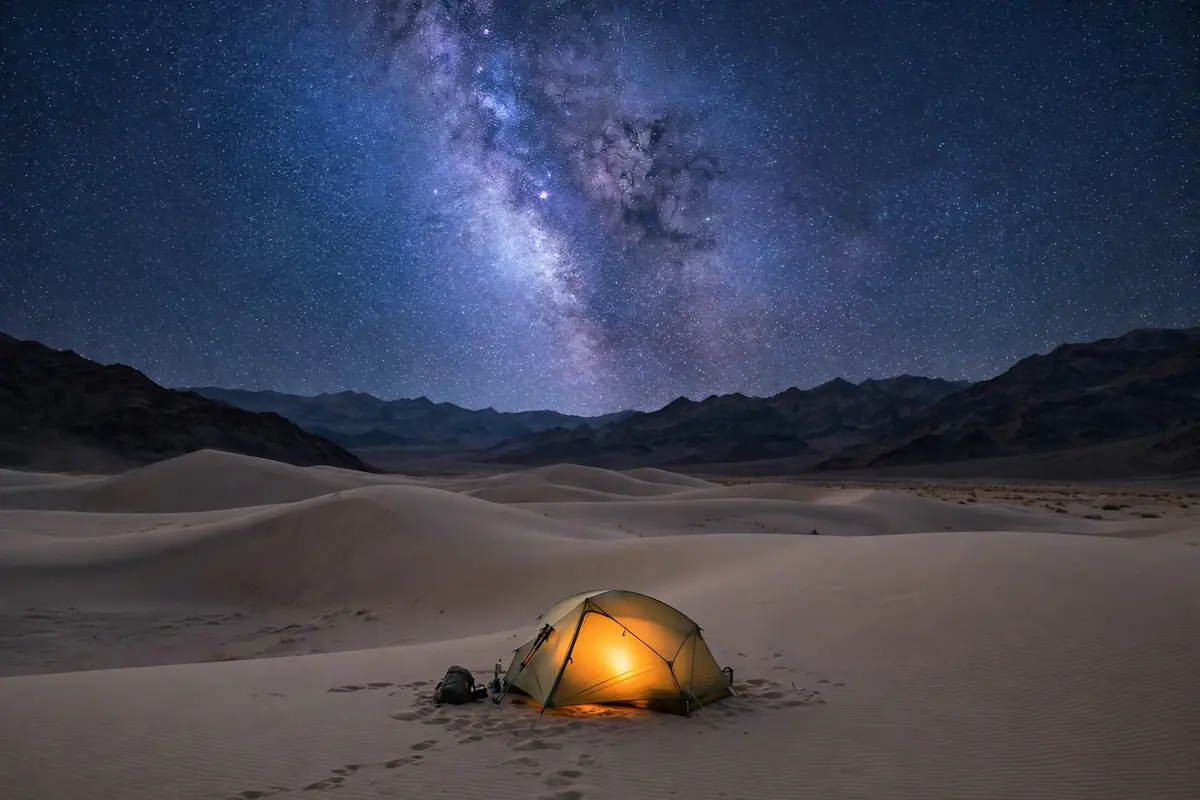
Death Valley holds the hottest temperature ever recorded on Earth — 134°F at Furnace Creek — and the lowest point in North America, Badwater Basin at 282 feet below sea level. It is the largest national park in the Lower 48, a land of salt polygons, singing sand dunes, and night skies so dark the Milky Way casts shadows. And the best way to experience it is to sleep in it. Death Valley camping puts you on the valley floor for sunrise at Zabriskie Point, under some of the darkest skies in America, and within an hour of landscapes that look like other planets. This 2026 guide covers all nine NPS campgrounds, real fees, the reservation system, and the desert survival rules that keep the trip magical instead of miserable.
Timing is everything here. The ideal camping season runs November through March, when daytime highs sit in the 60s and 70s and nights are crisp. Summer is genuinely dangerous — the average July high is about 116°F — and only the high-elevation campgrounds or air-conditioned gateway towns make sense. If you are new to desert camping, start with our beginner camping guide for the fundamentals, then come back for the Death Valley specifics. Pair the trip with our Joshua Tree hikes guide for the ultimate California desert doubleheader.
Death Valley Camping: The 9 NPS Campgrounds
1. Furnace Creek — The Only Reservable Campground
Furnace Creek is the park’s flagship: 136 sites at 196 feet below sea level, the lowest campground elevation in North America, open year-round. Standard sites run $30 per night; 18 full-hookup sites cost $44. Reservations are required from October 15 to April 15 through Recreation.gov and book out months ahead — the window opens six months in advance. From mid-April to mid-October it drops to 41 first-come, first-served sites. You get flush toilets, drinking water, a dump station, and a camp store, plus bragging rights for sleeping at the lowest spot in the hemisphere. The 14-night limit (October–May, 30 days total per year) keeps turnover moving. This is the base camp for first-timers and anyone who wants hookups near the visitor center. For trip-planning math, our budget travel tips help stretch every dollar.
2. Texas Spring — The Quieter Neighbor
Just minutes from Furnace Creek, Texas Spring offers 92 sites (26 tent-only) for $20 a night, first-come, first-served, October through April. No generators are allowed, which makes it noticeably quieter and more pleasant than its big sibling, with slightly elevated terrain and shady spots on the south end. It is the tent camper’s answer to Furnace Creek — same central location, better atmosphere, lower price. Arrive by mid-afternoon in peak season; it fills daily.
3. Sunset — The Reliable Overflow
Sunset’s 230-plus sites at $18 a night make it the park’s pressure valve: big, simple, first-come, first-served, October through April, with no RV length limit. It lacks the charm of Texas Spring, but when everything else is full at 4 p.m. on a February Friday, Sunset is the reason you still have a place to sleep. Think of it as the dependable backup plan, not the destination. It works well for large groups and late arrivals, and its sheer size means it is rarely completely full.
4. Stovepipe Wells — Best Base for the Dunes
Stovepipe Wells sits in the central park corridor with 190 sites at $18 a night, first-come, first-served, roughly October through mid-April, and no RV length limit. Its superpower is location: minutes from the Mesquite Flat Sand Dunes and Mosaic Canyon, the two most photogenic stops in the park. The adjacent private RV park offers the only other hookup option besides Furnace Creek. Sunrise at the dunes — when the rippled sand glows gold and your footprints are the only ones there — is worth the entire trip. Afterwards, the red-rock country in our Arches hikes guide makes a natural next stop on a Southwest loop.
5. Mesquite Spring — The Northern Outpost
At 1,800 feet on the park’s north end, Mesquite Spring’s 30-odd sites ($20 a night, first-come, first-served, year-round) are the quiet choice for exploring Ubehebe Crater and the Racetrack Playa. It is calmer than the Furnace Creek cluster and a reliable year-round option when valley-floor campgrounds close for summer. The dark skies up here are exceptional — this is deep stargazing country in the truest sense.
6. Wildrose — Free Camping in the Panamints
Wildrose sits at 4,100 feet in the Panamint Mountains with 23 free sites, first-come, first-served, year-round (weather permitting) — and it is the only high-elevation campground with potable water. It handles smaller RVs (25 feet max) and serves as the base for the Charcoal Kilns and Wildrose Peak. Free, quiet, and cool when the valley floor bakes: in summer, this is one of the only sane places to camp inside the park. The ten-site limit on vehicle length keeps the big rigs away.
7. Thorndike and 8. Mahogany Flat — The High Wild
These two tiny campgrounds — Thorndike at 7,400 feet (6 sites) and Mahogany Flat at 8,200 feet (9 sites) — are for experienced campers comfortable with primitive conditions, no water, and high-clearance vehicle requirements. Mahogany Flat is the trailhead for Telescope Peak (11,043 feet), the park’s highest summit, where you can stand above the desert and see both the lowest and highest points of the contiguous United States on a clear day. Both are free, first-come, first-served, roughly March through November. The road to Mahogany Flat is not for low-clearance vehicles — believe the signs.
9. Emigrant — The Free Ten-Site Hideaway
Emigrant’s 10 tent-only sites at 2,100 feet are free, first-come, first-served, year-round — a simple, no-frills stop on the park’s western side. No amenities beyond the basics, but also no fee and rarely any crowd. It is the kind of place you find once and return to forever. For more off-the-beaten-path overnights, the primitive Eureka Dunes and Saline Valley campgrounds (4WD recommended) offer the park’s deepest solitude.
2026 Fees and Reservations
Park entrance is $30 per private vehicle for seven days ($15 per person on foot or bike, $25 per motorcycle), and the park is cashless — cards or digital payment only, with self-service pay stations at Furnace Creek, Zabriskie Point, and Badwater. A Death Valley annual pass costs $55; the $80 America the Beautiful pass covers it and every other federal park. Note the 2026 policy change: free entrance days are now restricted to US citizens and residents — international visitors pay standard fees even on free days. Furnace Creek reservations open six months ahead on Recreation.gov for October 15–April 15; everything else is first-come, first-served. In peak season (December–March), arrive at FCFS campgrounds by early afternoon or have Sunset as your backup. As of October 2026, Scotty’s Castle remains closed for flood recovery — check the park’s conditions page before finalizing plans, since desert roads wash out fast.
Desert Survival: The Non-Negotiable Rules
Death Valley demands respect, and the rules are simple. Carry at least one gallon of water per person per day — you will not notice yourself sweating because it evaporates instantly. Never hike in the heat of a summer day; stick to paved areas, stay with your car if it breaks down, and keep the air conditioning in mind as safety equipment. Fill your gas tank before entering (stations at Furnace Creek, Stovepipe Wells, and Panamint Springs charge desert prices), download offline maps because cell service is nearly nonexistent, and carry a paper map. Tell someone your plan. The park is about 2.5 hours from Las Vegas, making it an easy add-on to a Route 66 road trip or a greater Southwest loop — and the Pacific Coast Highway pairs beautifully for a California grand tour. For waterfall contrast after the desert, our Havasu Falls guide is the Southwest’s other great pilgrimage, while the Capitol Reef area extends the red-rock journey.
Stargazing: The Other Reason to Camp
Death Valley is one of the largest International Dark Sky Parks in the world (Gold-tier designated), and camping here means the night sky becomes the main event. On moonless nights the Milky Way is bright enough to cast faint shadows, and the park’s ranger-led night sky programs run through the winter season. The best viewing is at the high-elevation campgrounds and the Racetrack Playa, far from Furnace Creek’s lights. Bring a red flashlight, a warm layer (desert nights drop 30 degrees from daytime highs), and a star app — then just lie back.
Frequently Asked Questions About Death Valley Camping
When is the best time to camp in Death Valley?
November through March, when highs run 60s–70s°F. Summer camping is dangerous on the valley floor; use Wildrose or the high Panamint campgrounds, or stay in gateway towns.
Do I need reservations?
Only Furnace Creek takes reservations (October 15–April 15 via Recreation.gov). The other eight NPS campgrounds are first-come, first-served — arrive early in peak season.
Is there cell service in Death Valley?
Barely. Expect no service across most of the park. Download offline maps, carry a paper map, and tell someone your itinerary.
Can I camp for free in Death Valley?
Yes — Wildrose, Thorndike, Mahogany Flat, and Emigrant are free, and backcountry camping is free with NPS rules (set back from roads and water sources; some areas off-limits).
Conclusion
Death Valley camping is the rare trip that delivers two parks in one: a daytime wonderland of dunes, salt flats, and painted canyons, and a nighttime cathedral of stars. Pick the campground that matches your style — reservable comfort at Furnace Creek, quiet pines at Wildrose, or free solitude at Emigrant — respect the desert’s rules, and you will understand why the hottest, driest, lowest place in North America inspires such fierce devotion.