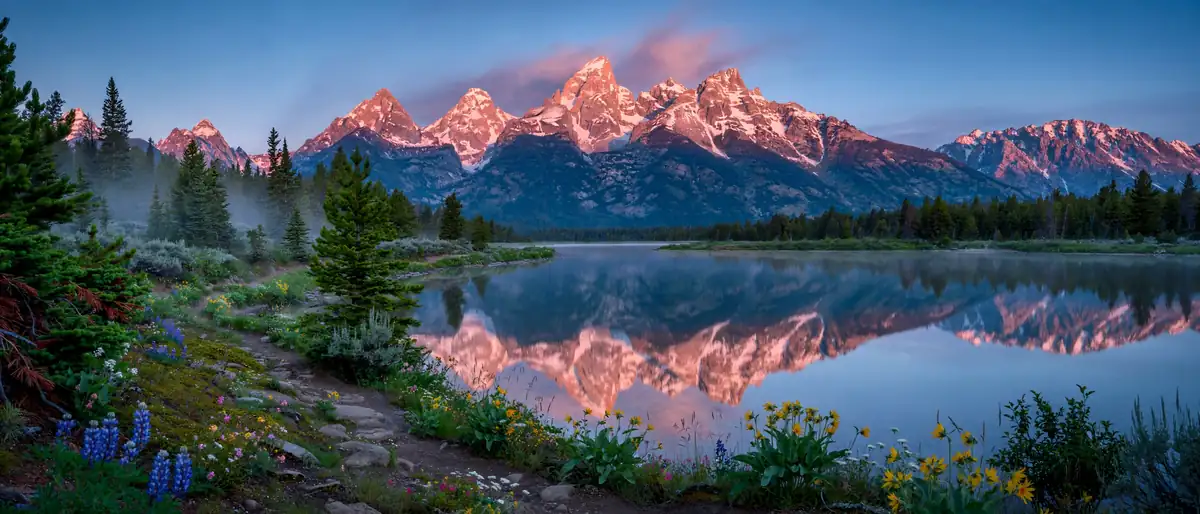
Few mountain ranges on Earth announce themselves like the Tetons. There are no foothills, no gentle prelude — the Cathedral Group simply erupts from the floor of Jackson Hole, rising 7,000 feet straight into the Wyoming sky. Grand Teton, at 13,775 feet, is the crown of a 40-mile range that has stopped travelers mid-step for centuries. The best Grand Teton hikes take you into the heart of that vertical world: up glacier-carved canyons, past sapphire alpine lakes, and along ridges where moose wade through wildflowers and grizzlies patrol the berry slopes. This guide ranks the seven trails that deliver the range’s full drama.
Established in 1929 and spanning 310,000 acres, Grand Teton welcomes around 3.3 million visitors a year — yet most never go farther than the Jenny Lake overlook. That is their loss. The best hiking trails in the USA often hide their rewards behind a boat shuttle or a few thousand feet of climbing, and the Tetons are the ultimate example. One essential fact shapes every hike here: this is grizzly and black bear country. Carry bear spray on every trail, know how to use it, make noise on blind corners, and store food properly. The bears were here first.
The Best Grand Teton Hikes, Ranked
1. Cascade Canyon — The Single Best Hike in the Park
If you do one hike in Grand Teton, take the Jenny Lake shuttle boat across the lake (about $18 round trip, running roughly mid-May through September) and climb into Cascade Canyon. The trail passes Hidden Falls — a 200-foot cascade tucked in a granite bowl — and Inspiration Point within the first mile, then opens into a wide U-shaped canyon with Mount Owen and Teewinot rising sheer on both sides. The standard route runs about 9 miles round trip to the canyon forks with 1,100 feet of gain: moderate, magnificent, and the most popular backcountry hike in the park for good reason. Take the first ferry around 7 a.m. to beat the 9 a.m. crowds. The canyon forks at mile 4.5 — north to Lake Solitude, south toward Hurricane Pass — and even turning around at the forks delivers one of the finest canyon walks in the American West. It belongs in any conversation with the best hikes in Glacier, its northern cousin in big-mountain drama.
2. Delta Lake — The Most Dramatic Alpine Lake
Delta Lake sits in a cirque beneath the Grand Teton itself, its turquoise water backed by one of the most sheer mountain walls in North America — and the trail is unofficial, unmaintained, and absolutely worth it. The route branches off the Amphitheater Lake trail and climbs steeply through boulder fields for about 7.4 miles round trip with 2,300 feet of gain. There is no official trailhead sign; navigation skills and a downloaded map are essential. Strong hikers with an early start should choose this over anything else in the park: the moment the lake appears, framed by the Cathedral Group, is the single most dramatic reveal in Grand Teton hiking. Because the route is unofficial, check current conditions and carry the Ten Essentials. Compare the commitment with the steep classics in our Rocky Mountain hikes guide.
3. Taggart Lake and Bradley Lake Loop — The Perfect First Teton Hike
The Taggart and Bradley Lakes loop (about 4 to 6 miles depending on your exact route, with modest elevation gain) is the ideal introduction to the Tetons: two glassy lakes, wildflower meadows, views of the Grand, and a fraction of the Jenny Lake crowds. Taggart Lake’s outlet stream and beaver ponds make it superb for moose spotting at dawn. The trailhead is just south of Jenny Lake, parking is easier, and the loop format keeps the scenery changing. This is the hike to choose on arrival day, when your legs are fresh and your camera battery is full. It pairs beautifully with an afternoon at the Capitol Reef area on a longer Utah-Wyoming itinerary — different geology, same wide-open West.
4. Lake Solitude via Cascade Canyon — The Full-Day Classic
Push past the Cascade Canyon forks another 4.8 miles and you reach Lake Solitude, a jewel of a lake at 9,035 feet ringed by peaks — a 14-plus-mile round trip that ranks among the great day hikes in America. The trail climbs gently through the upper canyon, past marmot colonies and paintbrush meadows, with the Grand Teton revealing itself in stages. Strong hikers do it in a long day; others split it with a backcountry permit. Snow lingers into July, so check conditions before committing. An alternative: the Paintbrush Canyon–Cascade Canyon loop (about 19 miles) links two canyons over Paintbrush Divide for the park’s ultimate single-day traverse. Either way, this is expedition hiking — train for it like you would the long routes in our Olympic hikes guide.
5. Phelps Lake via Death Canyon — Waterfalls and Wildlife
The trail to Phelps Lake runs about 6 miles round trip through the Laurance S. Rockefeller Preserve, a donated 1,100-acre sanctuary that feels like the park’s quiet soul. The route follows Death Canyon’s creek past small cascades to a stunning overlook, then descends to the lake’s shore, where a famous jumping rock tempts the brave. Moose frequent the willows at dawn and dusk, and the preserve’s strict day-use rules keep crowds low. It is less famous than the Jenny Lake trails and all the better for it. For more wildlife-rich hiking, our Acadia hikes guide covers the East Coast’s tamer but lovely equivalent.
6. Jenny Lake Loop — The Lakeshore Stroll
The 7.3-mile loop around Jenny Lake is mostly flat, endlessly scenic, and the best easy full-morning hike in the park. The west side passes the Hidden Falls and Inspiration Point junctions (combine them for a superb half day), while the east side offers the classic postcard reflections of the Cathedral Group on calm mornings. Moose and black bears frequent the shoreline — keep your distance and your spray handy. Start at dawn for mirror-calm water and empty trail. Afterwards, the nearby town of Jackson makes a lively base; for trip-planning strategy, see our ultimate USA road trip planner for linking the Tetons with Yellowstone, just 50 miles north on the same $35 entrance pass.
7. Paintbrush Canyon to Holly Lake — The Wildflower Hike
Paintbrush Canyon is Cascade Canyon’s wilder sibling: a 10-mile round trip to Holly Lake through meadows that explode with Indian paintbrush, lupine, and columbine in July. The trail climbs about 2,700 feet past towering canyon walls, with the Grand Teton looming at the canyon’s head. It sees a fraction of Cascade’s traffic, and the wildflower display rivals anything in the Rockies. Grizzly activity is real here — this is prime bear habitat, so hike in groups, make noise, and carry spray where you can reach it in seconds. The flower season overlaps with the high-country bloom in our Zion hikes guide season, making July the month of wildflower pilgrimages across the West.
Best Time to Hike Grand Teton
July through September is the prime window: trails are snow-free, the Jenny Lake ferry runs, wildflowers peak in July, and the weather is most stable. High routes like Lake Solitude and the Paintbrush Divide hold snow into July, so check the park’s conditions page before committing to a long day. June can be lovely at lower elevations but expect mud and snow patches above 9,000 feet. September brings golden aspens, bug-free trails, and thinner crowds — many locals call it the best month. October is gorgeous but short; the first big snow can close high trails overnight, and the ferry stops running in late September. Winter transforms the park into a cross-country skiing and snowshoeing destination, with the park road groomed for skiers.
2026 Fees, Bear Safety, and Logistics
Entry is $35 per private vehicle for seven days — and the pass covers Yellowstone too if you visit within the same period, since the parks share a combined fee. The $80 America the Beautiful pass covers both and pays for itself on any multi-park trip. This is serious bear country: carry EPA-registered bear spray on every hike (rentals are available in Jackson), hike in groups of three or more where possible, make noise on blind corners and in dense brush, and never approach wildlife. The park enforces temporary trail and area closures for denning bears and nesting eagles — check the alerts page before you go. Jenny Lake parking fills by 9 a.m. in summer; the park’s lots are small by design. New to backcountry logistics? Our beginner camping guide and budget backpacking tips cover the gear, food, and planning that make Teton trips smooth.
Frequently Asked Questions About Grand Teton Hikes
Do I need a permit to day-hike in Grand Teton?
No permit is needed for day hiking. Overnight backcountry trips require a permit, reservable in advance on Recreation.gov, and popular zones book out months ahead.
Is the Jenny Lake ferry worth it?
Yes — it saves about 4 miles round trip and the crossing itself is beautiful. Buy tickets early in the day; the first boat (around 7 a.m.) gets you ahead of the crowds.
Will I see a grizzly bear?
Possibly, especially in the canyons and around Jackson Lake Lodge. Sightings are a privilege, not a goal: stay 100 yards away, never run, and carry spray.
Can I combine Grand Teton and Yellowstone?
Absolutely — they are 50 miles apart and share the entrance pass. Give the Tetons at least two full days of hiking before heading north.
Conclusion
The best Grand Teton hikes share one quality: they put you inside the vertical world instead of in front of it. Whether you choose the essential Cascade Canyon, the drama of Delta Lake, or a quiet morning loop around Taggart Lake, the Tetons reward the hiker who goes beyond the overlook. Carry spray, start early, respect the bears — and let the most abrupt mountains in America do the rest.