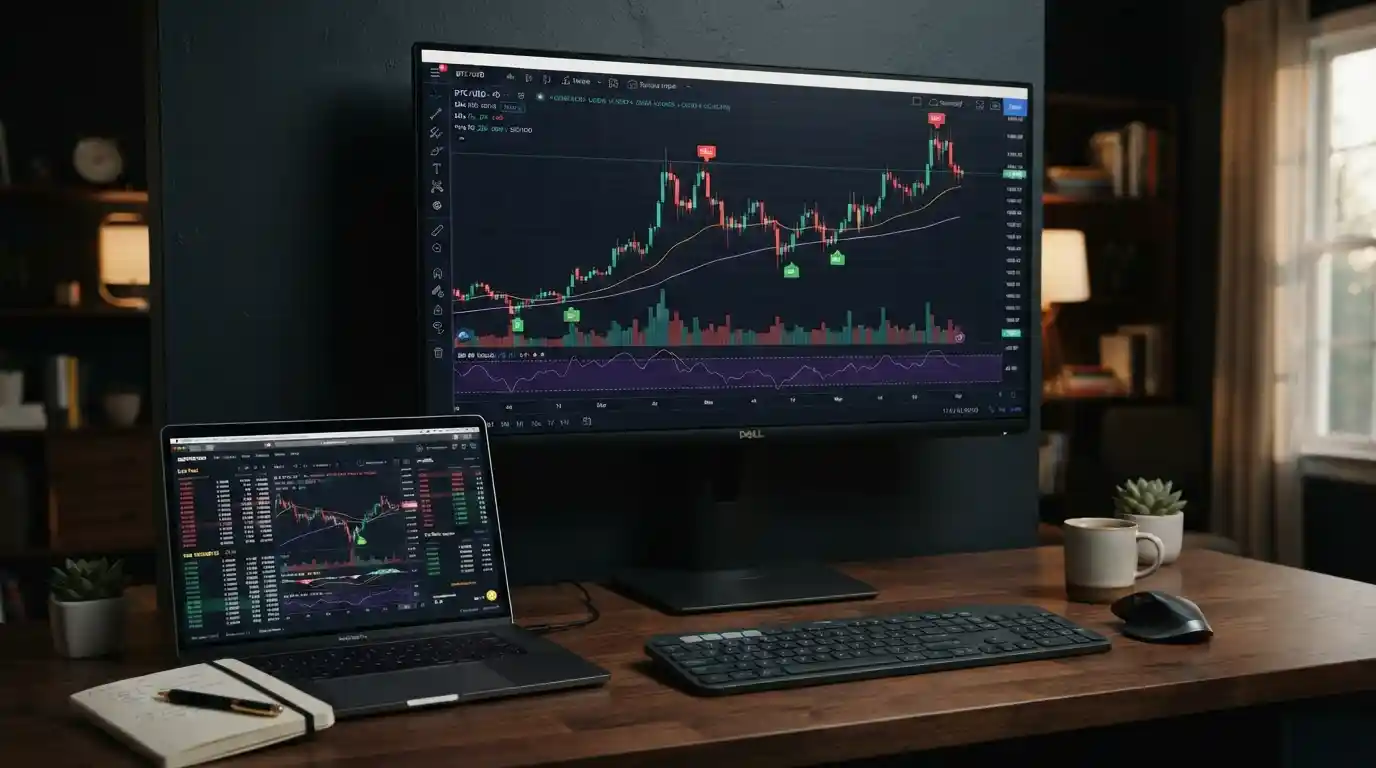
Crypto markets can move quickly, which makes timing important for both short-term traders and investors. A well-designed signal can turn large amounts of market data into a simpler trading idea, such as a potential buy, sell, or wait condition. The challenge is learning how those signals are created, how to evaluate them, and when it is better to ignore them.
This guide explains how cryptocurrency buy and sell signals work, which indicators commonly support them, how traders can evaluate signal providers, and how to build a more disciplined approach to using trading signals.
What Are Cryptocurrency Buy Sell Signals?
Cryptocurrency buy sell signals are trading indications designed to suggest when a particular digital asset may have a favorable opportunity for entering or exiting a position. Depending on the system, a signal may be generated from technical indicators, price patterns, trading volume, market momentum, volatility, or a combination of several data points.
A basic signal may contain information such as the cryptocurrency being analyzed, the potential entry price, a suggested target, a stop-loss level, and the timeframe involved. More sophisticated systems can also incorporate multiple indicators and market conditions before producing an alert.
For traders exploring different parts of the cryptocurrency market, related topics such as the cryptocurrency OTC market can provide additional context about how larger transactions and liquidity can differ from ordinary exchange trading.
The important point is that a signal should be viewed as information rather than a promise. Markets remain uncertain, and even a signal based on several indicators can fail when conditions change unexpectedly.
How Cryptocurrency Buy and Sell Signals Work
Signal systems generally collect market information and process it according to predefined rules. The system may examine price trends, momentum, volatility, volume, moving averages, or other technical measurements.
When several conditions align, the system may produce a bullish or bearish indication. For example, a bullish setup could occur when price moves above an important moving average while momentum indicators also begin strengthening. A bearish setup may appear when momentum weakens and price loses an important support level.
The exact rules vary considerably between signal providers. Some systems rely primarily on technical analysis, while others combine technical data with market sentiment, news analysis, on-chain information, or automated models.
Traders interested in broader cryptocurrency technology can also explore Plasma cryptocurrency and digital finance to understand how developments within the wider crypto ecosystem can influence market discussions and trading narratives.
Common Types of Crypto Trading Signals
Buy Signals
A buy signal generally indicates that a system has identified conditions that may support an upward price movement. The indication could be based on a breakout, improving momentum, a trend reversal, oversold conditions, or a combination of several technical factors.
A buy signal does not mean that a trader should immediately enter a position. Traders should consider whether the signal agrees with the broader trend, whether liquidity is sufficient, and whether the potential reward justifies the risk.
Sell Signals
A sell signal can indicate that upward momentum is weakening or that conditions may favor an exit or short-term bearish move. Depending on the strategy, the signal could be triggered by a trend reversal, loss of support, declining momentum, or an overbought condition.
For someone holding cryptocurrency as part of a longer-term portfolio, a short-term sell signal may have a different meaning than it does for a day trader. This is why the timeframe behind a signal matters.
Hold or Neutral Signals
Not every market condition provides a clear trading opportunity. Some signal systems therefore produce hold, neutral, or wait signals when indicators conflict or when market conditions lack a strong directional trend.
These signals can be valuable because avoiding a low-quality trade is also a trading decision. Waiting for stronger confirmation can sometimes be more effective than entering a position simply because the market is moving.
Technical Indicators Used in Cryptocurrency Signals
Most cryptocurrency signal systems use one or more technical indicators. Understanding the underlying indicators can help traders evaluate whether a signal makes sense instead of blindly following an alert.
Moving Averages
Moving averages smooth price data and help traders identify the general direction of a market. Shorter moving averages respond more quickly to recent price changes, while longer moving averages can provide a broader view of the trend.
Crossovers between different moving averages are commonly used as potential trend signals. However, moving averages can react slowly during rapidly changing markets, so traders often combine them with other indicators.
Relative Strength Index
The Relative Strength Index, commonly called RSI, measures momentum and is often used to identify potentially overbought or oversold conditions.
An unusually high RSI may indicate strong recent momentum, while a low RSI may indicate that selling pressure has been significant. Neither condition automatically means that a cryptocurrency must reverse. Strong trends can remain overbought or oversold for extended periods.
MACD
The Moving Average Convergence Divergence indicator, or MACD, is frequently used to analyze momentum and potential trend changes. Traders may examine MACD crossovers, histogram changes, and the relationship between the MACD line and signal line.
MACD can become more useful when combined with price structure rather than being treated as an independent buy or sell trigger.
Bollinger Bands
Bollinger Bands help traders evaluate price volatility. The bands expand when volatility increases and contract when volatility decreases.
Traders may use the indicator to identify periods of unusually strong movement or changing volatility. However, touching or crossing a band by itself does not guarantee a reversal.
Trading Volume
Volume can help traders assess whether a price movement has meaningful participation behind it. A breakout supported by strong volume may be interpreted differently from a similar price move occurring on weak volume.
Combining price, volume, momentum, and trend information can produce a more complete picture than relying on one indicator alone.
How to Confirm a Cryptocurrency Trading Signal
One of the biggest mistakes beginners make is treating every alert as an instruction to trade immediately. Confirmation can help reduce the number of low-quality setups.
A trader might first determine the overall market trend, then examine support and resistance levels, momentum, volume, and volatility. If several factors support the same conclusion, the setup may deserve further consideration.
For example, a potential buy signal may become more interesting when the broader trend is positive, price breaks above resistance, volume increases, and momentum indicators confirm the move. If the same signal appears directly below strong resistance with weak volume, the setup may deserve more caution.
Traders can also compare short-term signals with longer-term market conditions. This prevents a small movement on a short timeframe from being mistaken for a major trend reversal.
Cryptocurrency Buy Sell Signals and Different Trading Styles
Day Trading
Day traders generally focus on short-term price movements and may use signals across minutes or hours. Because positions may be opened and closed within the same trading session, execution speed and transaction costs can become important considerations.
Short-term traders should also be careful about overtrading. Receiving multiple signals does not mean every signal deserves a position.
Swing Trading
Swing traders usually attempt to capture larger price movements over several days or weeks. They may combine signals with trend analysis, support and resistance, and broader market structure.
A swing trader may therefore use a short-term signal as confirmation rather than as the sole reason for entering a trade.
Long-Term Investing
Long-term investors typically have different objectives from active traders. A short-term sell signal may not justify changing a long-term investment thesis, particularly when the position was originally established around fundamental or portfolio considerations.
For readers interested in the investment side of cryptocurrency rather than active signal trading, investing in Bitcoin provides a useful related topic to consider alongside short-term trading strategies.
How to Choose a Cryptocurrency Signal Provider
The quality of a signal provider matters because traders may make financial decisions based on the information they receive. A provider should therefore be evaluated carefully instead of being selected because of impressive marketing claims.
Look for Transparent Methodology
A credible provider should explain, at least at a high level, how signals are generated. Traders should understand whether the system relies on technical indicators, automated algorithms, market data, sentiment analysis, or another methodology.
Review Historical Performance Carefully
Historical results can provide useful information, but they should not be interpreted as a guarantee of future performance. Pay attention to the number of trades, losing trades, average gain and loss, drawdowns, and the conditions under which the results were achieved.
Be Careful With Guaranteed Profit Claims
Claims of guaranteed returns should be treated with extreme caution. Cryptocurrency markets are uncertain, and no legitimate signal system can eliminate market risk.
A provider that focuses entirely on huge winning percentages while ignoring losses, drawdowns, fees, and unfavorable market conditions may not provide enough information for responsible decision-making.
Consider Security and Privacy
Trading platforms and signal services may require users to provide account information, API credentials, or other sensitive data. Traders should understand what permissions a service requests and avoid giving unnecessary access to funds or accounts.
Risk Management Is More Important Than Signal Accuracy
Even an accurate signal strategy can experience losing trades. This makes risk management a central part of any cryptocurrency trading approach.
One practical principle is to determine the maximum acceptable loss before entering a position. A trader can then choose a position size that keeps the potential loss within that limit.
Stop-loss orders may also be used where appropriate to define an exit point if the market moves against the trade. However, stop orders are not guaranteed to execute at exactly the desired price during fast or illiquid market conditions.
Position sizing, diversification, realistic profit targets, and disciplined exits can all help prevent a single unsuccessful trade from causing disproportionate damage to a portfolio.
Why Cryptocurrency Signals Can Fail
No signal system can predict every market movement. Signals can fail for several reasons, including sudden news, unexpected liquidity changes, market-wide selling, false breakouts, unusual volatility, and changes in trader sentiment.
Technical indicators are also based on historical market information. They describe what has happened and provide frameworks for interpreting current conditions, but they cannot guarantee what will happen next.
Another problem occurs when traders use a signal outside its intended timeframe. A signal designed for short-term trading may become misleading when interpreted as a long-term investment recommendation.
Similarly, a signal can be technically correct but still produce an unsuccessful trade because the entry occurs too late or the market reverses immediately after the alert.
Cryptocurrency OTC Trading and Signal Interpretation
Not every cryptocurrency transaction takes place through the same type of market. The cryptocurrency OTC market can involve large transactions arranged outside the conventional order-book environment used by many retail traders.
This distinction matters because liquidity, execution, pricing, and transaction structure can differ between market environments.
Understanding different trading environments can help traders avoid assuming that a signal developed for one type of market will behave identically in another.
Cryptocurrency Signals and Emerging Digital Finance
The cryptocurrency market continues to evolve alongside blockchain infrastructure, financial technology, decentralized applications, and new digital-asset models. This broader ecosystem can influence the narratives and market expectations surrounding individual assets.
Topics such as Plasma cryptocurrency illustrate how developments in blockchain technology can become part of the wider digital-finance conversation.
Likewise, the relationship between cryptocurrency and traditional financial products is becoming an increasingly discussed subject. The topic of cryptocurrency mortgages demonstrates how digital assets can intersect with conventional financial concepts.
Can You Mine Cryptocurrency on a Phone?
Cryptocurrency trading signals and cryptocurrency mining are separate concepts, although both belong to the broader digital-asset ecosystem.
Mining involves using computing resources to participate in the validation or production process of certain blockchain networks, while trading signals attempt to identify potential market opportunities.
Readers interested in the technical side of cryptocurrency can explore mining cryptocurrency with a phone to understand how mobile-based mining concepts differ from ordinary cryptocurrency trading.
How to Build a More Disciplined Signal-Based Trading Plan
A structured plan can make cryptocurrency buy sell signals more useful. Instead of reacting to every notification, traders can establish rules before entering the market.
- Define the trading timeframe. Decide whether the strategy is designed for intraday, swing, or longer-term decisions.
- Identify acceptable risk. Establish how much capital can be placed at risk on an individual trade.
- Choose confirmation indicators. Use a consistent combination of trend, momentum, price structure, and volume information.
- Define the entry condition. Know what must happen before a position is opened.
- Define the exit condition. Determine when profits will be taken and when a losing position should be closed.
- Record every trade. Maintain a trading journal containing the signal, entry, exit, reasoning, result, and lessons learned.
- Review performance regularly. Evaluate the strategy across a meaningful sample of trades instead of judging it from one or two outcomes.
Common Mistakes When Using Crypto Signals
Following Every Signal
More trades do not automatically mean more profits. A trader may receive several signals during a highly volatile period, but taking every opportunity can increase costs and exposure to poor setups.
Ignoring the Stop-Loss
Moving a stop-loss farther away simply because a trade is losing can turn a manageable loss into a much larger one. Risk parameters should be established before the trade whenever possible.
Using Excessive Leverage
Leverage can increase both potential gains and potential losses. A signal that would be manageable without leverage can become extremely risky when the position size is amplified.
Chasing Missed Entries
If the market has already moved significantly after a signal is issued, entering late can create a very different risk-reward profile. Sometimes the best decision is to wait for a new setup.
Confusing Past Performance With Future Results
A strategy that performed well during one market regime may behave differently during a sideways, bearish, or highly volatile environment. Market conditions change, and trading systems need to be evaluated accordingly.
Are Cryptocurrency Buy Sell Signals Worth Using?
Cryptocurrency buy sell signals can be useful when they are treated as analytical tools rather than automatic profit machines. Their greatest value may be in helping traders organize market information, identify potential setups, and maintain a repeatable decision-making process.
The quality of the underlying methodology matters more than the number of alerts a provider sends. Traders should understand the timeframe, indicators, risk assumptions, historical performance, and limitations of the system before relying on it.
Signals can also become more useful when combined with broader cryptocurrency knowledge. Understanding topics such as OTC crypto trading, blockchain developments, crypto-based financial products, and Bitcoin investing can help place individual trading decisions within a wider context.
Frequently Asked Questions
What are cryptocurrency buy sell signals?
Cryptocurrency buy sell signals are indications generated from market data and analytical rules that identify potential opportunities to enter, exit, or avoid a cryptocurrency trade.
Are crypto buy signals guaranteed to make money?
No. A signal can fail because cryptocurrency prices are unpredictable and affected by volatility, liquidity, news, market sentiment, and other factors.
Which indicators are commonly used for crypto signals?
Common indicators include moving averages, RSI, MACD, Bollinger Bands, support and resistance levels, and trading volume. Many strategies combine several indicators rather than relying on one measurement.
Should beginners use cryptocurrency trading signals?
Beginners can study signals as part of learning technical analysis, but they should understand the underlying methodology and risk before using real money. A signal should not replace independent research or a defined trading plan.
How can I reduce the risk of following a bad signal?
Use position sizing, predefined risk limits, confirmation from multiple market factors, and disciplined exit rules. Avoid providers that make unrealistic guaranteed-profit claims.
Are buy signals better than sell signals?
Neither is automatically better. Their usefulness depends on the market environment, trading strategy, timeframe, and risk-management rules.
Final Thoughts on Cryptocurrency Buy Sell Signals
Cryptocurrency buy sell signals can simplify complex market information and help traders identify potential opportunities, but they should never be treated as guaranteed instructions for making money. The strongest approach combines signals with technical analysis, market context, disciplined position sizing, and clearly defined risk limits.
As the cryptocurrency ecosystem continues to develop, traders will encounter new technologies, trading environments, and financial applications. Learning about related subjects such as Bitcoin investing, OTC cryptocurrency markets, cryptocurrency mining, and blockchain-based digital finance can provide additional perspective.
Ultimately, the goal should not be to find a signal that is right every time. A more realistic goal is to build a repeatable process that manages uncertainty, protects trading capital, and makes decisions based on evidence rather than emotion.